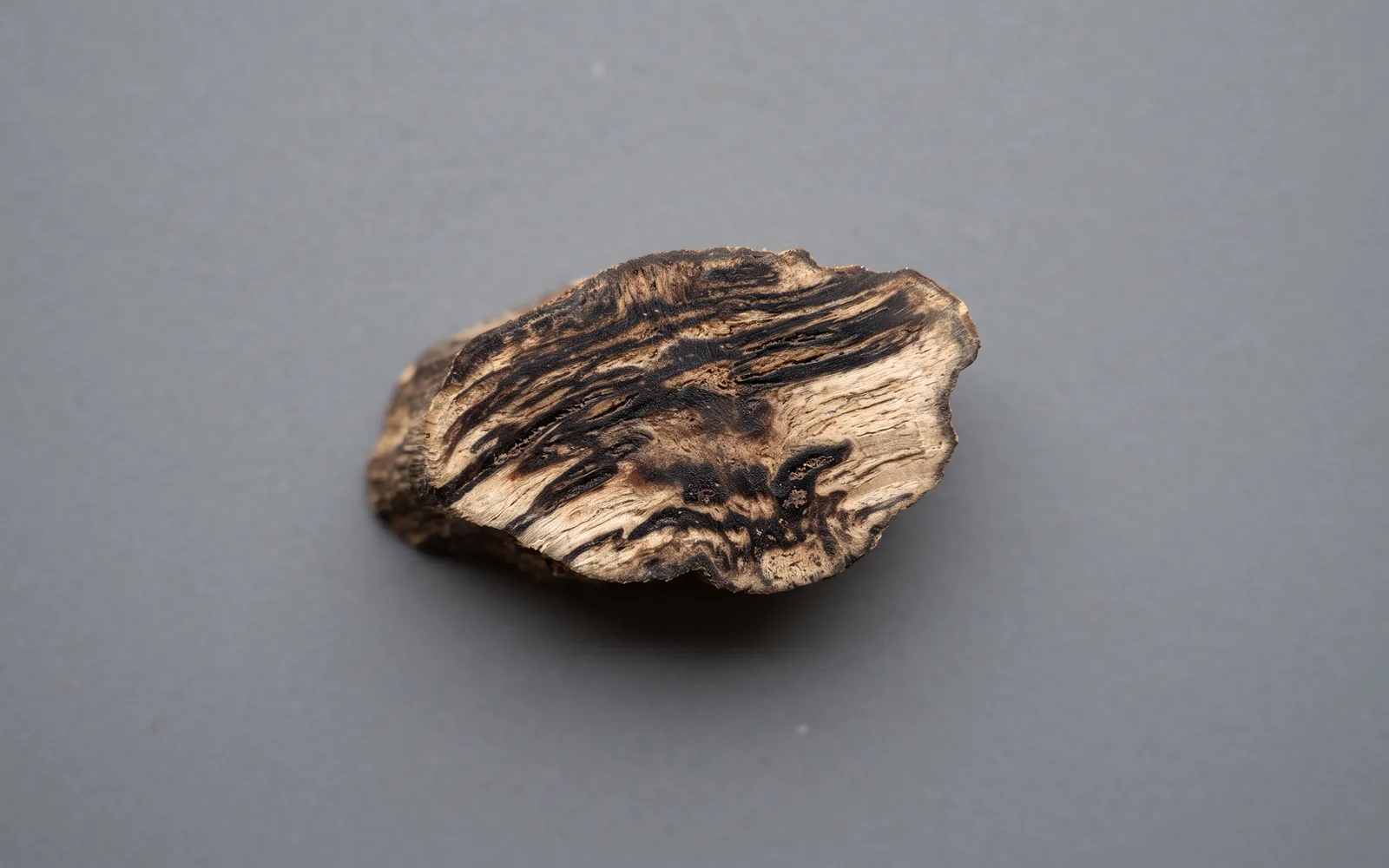
Grade · Entry to mid
Plantation Aquilaria — Grade, Documentation and Reproducibility
The grade you build a shelf position on. Consistent, documented, and available next year.
Grade characteristics
| Origin of resin | Managed induction — deliberate wounding or inoculation |
|---|---|
| Resin band | Low to medium-high |
| Reproducibility | High — matched against retained reference samples |
| Traceability | Source stand and induction date recorded per lot |
| Availability | Continuous — stock rather than allocated |
| Price band | Entry to mid |
| Best for | Volume retail, OEM, compliance-sensitive markets |
Grade detail
Understanding Plantation Aquilaria
Plantation Aquilaria is cultivated agarwood produced by managed induction — the tree is deliberately wounded or inoculated so that it forms the defensive resin that makes agarwood what it is. It accounts for the overwhelming majority of legitimate agarwood in trade and it underpins almost every product in our range.
Its defining commercial property is reproducibility. A wild lot is a one-off: you can build a collector SKU on it but you cannot build a retail shelf position that has to smell the same when the customer comes back next year. We can match plantation material against a retained reference sample and resupply it. That is what a retail buyer actually needs from a supplier.
The second property is traceability. Plantation source lots are recorded from stand and induction date. That means a claim about where the material came from can be checked rather than taken on trust. For anyone importing into the EU, US or Japan at volume, that difference is worth real money in avoided delays.
The honest limitation is resin concentration. Plantation material does not reach the density of top wild lots and does not produce the cool bittersweet signature of kynam. It is the correct choice for volume, consistency and compliance. It is the wrong choice if the specific thing you are selling is rarity. Anyone telling you plantation material matches kyara is selling you something else.
Sustainability is not a marketing overlay here, it is the reason the trade still exists. Wild Aquilaria populations were pushed onto international protected lists by exactly the demand this industry generates. Plantation cultivation with induced infection is the version of this business that is still operating in fifty years, and buying documented plantation material is a straightforward way of choosing that outcome.
What induction actually involves, since the word does most of the work in this grade name. A managed stand is planted and grown for years before anything is done to it. Then the tree is wounded or inoculated so that it begins laying down defensive resin. The resin accumulates over a further period, and only then is the tree harvested and the resinous fraction separated from the white wood.
The controllable variables are the induction method, the time between induction and harvest, and which fraction of the trunk a lot came from. Those three move the profile far more than the country name does. When we select within this grade for a specific application, those are the levers. Ask about them rather than about origin if you want to understand why two quotes differ.
What you get commercially is the ability to reorder. We hold a sealed reference sample of the profile you approved. A later batch is assessed against it before release. A run that has drifted does not ship under that grade. That is the whole mechanism, and it is why a retail shelf position can survive a second year on this material and cannot on a wild lot.
On price: plantation material spans a wide band on its own. An everyday low-smoke blend and a koh-grade selection are the same grade and differ by more than an order of magnitude on resin fraction and on cost. So a quote for plantation Aquilaria without an application attached to it is not really a quote. Tell us the shelf the product is going on.
A short note on what this grade cannot do. It will not give you the character of a decades-old wild piece, and no induction schedule changes that. What it gives you instead is a profile you can specify, reorder and defend on paper. For a retail range those are the properties that matter. For a single collector object they are not, and we would rather say so than sell you the wrong thing.
For a purchase order, three lines settle it: the grade, the intended application, and the destination. Application is the one buyers leave out, and it is the one that decides which material we select within the grade.
One last practical point. If you are switching to this grade from an unspecified supply, run the first order alongside your existing stock rather than replacing it outright. Burn them side by side in the environment your customer uses. That comparison tells you more in twenty minutes than any specification sheet. It gives you the language to explain the change to your own buyers.
Products at this grade
Plantation Aquilaria products
Coreless Agarwood Incense Sticks
The premium default. Extruded solid, so every second of the burn is agarwood.
Quote on request
Low-Smoke Agarwood Incense Sticks
Reduced-particulate blend for Western wellness retail. Where the coreless line is about what the stick is made of, this one is about what comes off it — same coreless body, reformulated for small rooms. Choose it when the complaint you are solving is smoke, not authenticity.
Quote on request
Arabic Oud Incense Sticks
The GCC format. Higher output per stick and a sweeter, bolder profile than East Asian styles.
Quote on request
Temple Long-Burn Sticks
Ceremonial and temple supply: extended burn, controlled ash, bulk packing. A different job from retail sticks.
Quote on request
Pure Agarwood Incense Powder
The unblended base material. Buy pure and control your own binder ratio.
Quote on request
Seal Incense Powder (香篆)
Specified for seal-incense pressing, where mesh and flow decide whether the product works at all. The pure powder is graded for burn and blending. This one is graded for how it falls out of a mould. If your customer is pressing patterns rather than heating chips, this is the one.
Quote on request
Batch-Traceable CO₂ Oud Extract
Sold by the documented lot, not by the product line. Batch number, sealed retention sample and 30-day reservation as standard; certificate of analysis and independent GC-MS on request.
Quote on request
Watch
Plantation material through the mill
Plantation-grown chips being milled into graded powder.
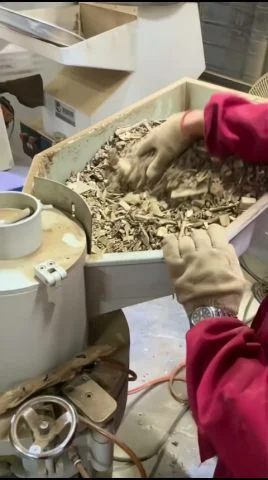
Plantation material through the mill
Plantation-grown chips being milled into graded powder.
Buyer Questions
Aquilaria — frequently asked questions
Is plantation agarwood "real" agarwood?
Yes. It is the same Aquilaria genus forming the same defensive resin through the same biological process — the difference is that infection is induced deliberately rather than occurring by chance. What varies is resin concentration and profile depth, not authenticity.
Why do you recommend it for retail programmes?
Reproducibility. A retail SKU has to smell the same on reorder. We match plantation material against a retained reference sample and resupply it. Wild lots are one-offs — excellent for a collector tier, unusable as the base of a continuing shelf position.
Does plantation material import more easily?
Yes, meaningfully. Source lots are recorded from stand and induction date. So a provenance claim can be checked against a record rather than accepted on trust. Wild-sourced consignments attract more scrutiny at the border precisely because that record does not exist.
Ordering, lead time, payment, shipping and claims are answered in full on the buyer FAQ.
Enquire about Plantation Aquilaria
Every grade we sell ships with a sealed retention sample and stated specifications. Ask for the documentation before you order rather than after.