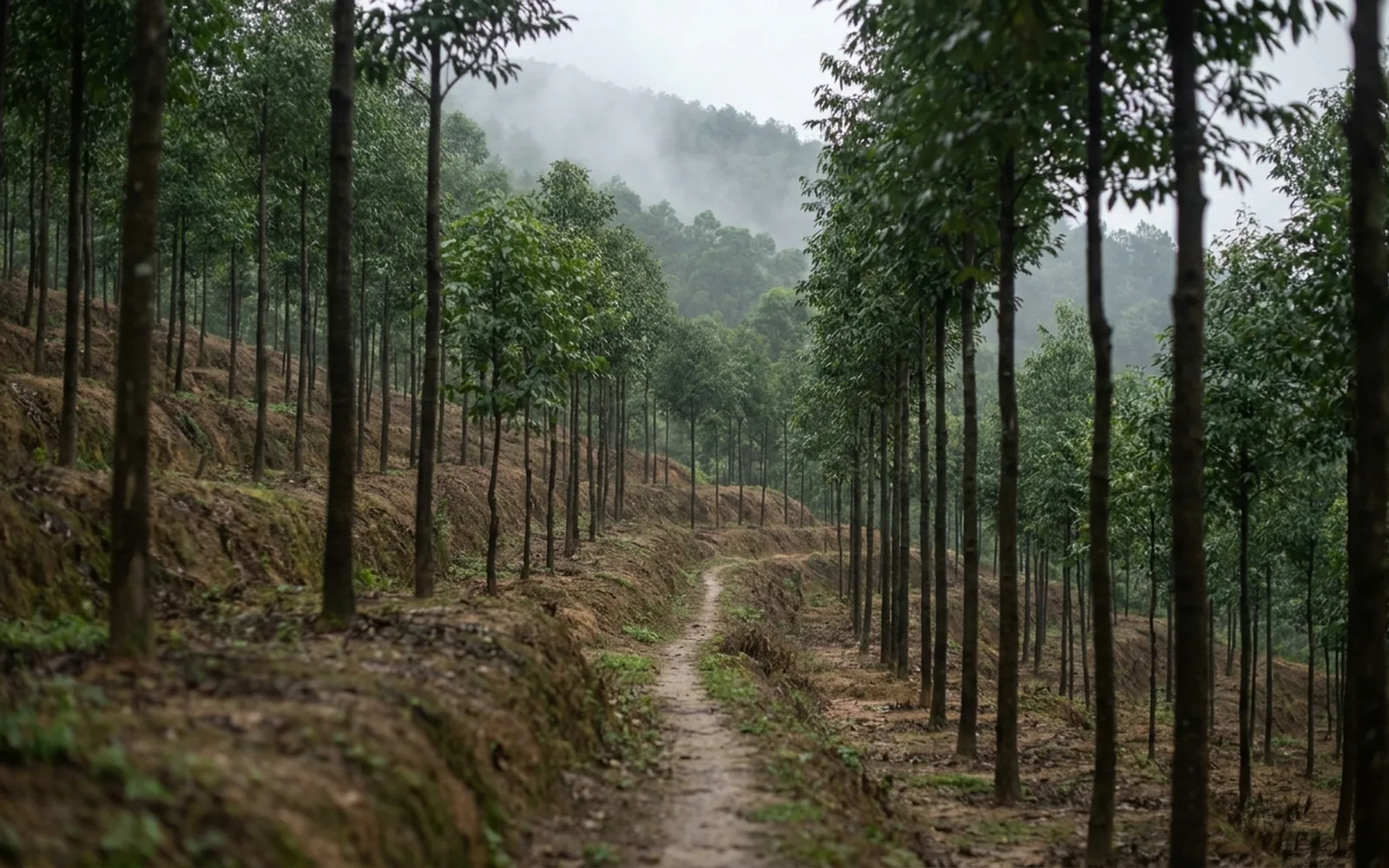
Southern China
Chinese Incense and Plantation Agarwood — Guangdong and Hainan
The reproducible one. If you need this year to smell like last year, it starts here.
Origin characteristics
| Species | Aquilaria sinensis |
|---|---|
| Provinces | Guangdong and Hainan — our own stands, recorded per lot |
| Cultivation | Plantation with managed induction |
| Resin band | Low to medium-high |
| Profile | Balanced woody-sweet, clean, minimal barnyard |
| Reproducibility | High — matched against retained reference samples |
| Traceability | Source stand and induction date recorded per lot |
| Best for | Volume stick and powder programmes, OEM, compliance-sensitive markets |
Origin detail
Sourcing from Guangdong & Hainan, China
Our stands sit in two southern Chinese provinces, Guangdong and Hainan, and between them they account for the whole of what we ship. Both grow Aquilaria sinensis under the same managed induction protocol. And we treat them as one supply base rather than two grades: the material is moderate in resin, balanced in profile and — the property that matters most commercially — reproducible from batch to batch. Which province a given lot came from is recorded on the paperwork. It is not a price tier, and any supplier turning a Chinese province into one should be asked what specifically changes.
That reproducibility is why Chinese plantation material underpins any serious retail programme. Wild-sourced agarwood from anywhere is a series of one-off lots. You can build a collector SKU on it but you cannot build a shelf position that has to smell the same next year. Plantation Aquilaria sinensis can be matched against a retained reference sample and re-supplied. That is what a retail buyer actually needs.
The traceability position is also cleaner. Plantation material carries a source lot recorded from stand and induction date. That is checkable in a way that a wild-collected consignment never is. For buyers importing into the EU, US or Japan, that difference shows up as fewer held containers.
The honest limitation: Chinese plantation material does not reach the resin concentration of top wild lots from Vietnam or the deep animalic character that a long fermentation soak on wild wood produces. It is the right choice for volume, consistency and compliance. The wrong choice if you are specifically chasing a collector profile.
What being in this region actually gives a buyer, beyond a line on the invoice. Guangdong and Hainan are where Aquilaria sinensis grows natively. That means the planting stock, the induction know-how and the processing capacity are all in the same place. Material does not cross a border between harvest and mill. That shortens the traceability chain to something you can actually audit.
The practical effect shows up in queries. When a broker asks which block a lot came from and in what year, that is a records question rather than an investigation. When a buyer asks for a second lot matched to the first, the reference sample and the stand are both here. Neither of those is possible when material has been bought on an open market two countries away.
On climate and cycle: the growing season here supports a managed rotation measured in years rather than decades, and induction is scheduled rather than opportunistic. That is what makes volume predictable. It is also why the profile from this region reads as clean and slightly sweet rather than as the heavy, animalic character associated with much older wild material from further south.
One honest limitation. Origin is a weaker differentiator than most suppliers imply. Two lots from the same stand can differ more than two lots from different countries, because induction method and time on the tree move the profile further than geography does. Use origin for documentation and legality, which is where it genuinely decides outcomes. Use grade and application for scent.
A note on what the region does not give you, so the expectations are set correctly. It does not give you the character of very old wild material, and no plantation region does. It does not give you a lower price than open-market sourcing, because managed stands cost more to run than buying whatever is available. What it gives you is the ability to answer a provenance question with a record rather than an assurance.
On seasonality: harvest and induction here run on a schedule, so lead times are predictable rather than opportunistic. That matters more than it sounds for anyone planning a seasonal programme, because it means a production slot can be booked against a shelf date rather than hoped for.
Products from this origin
What we make with Guangdong & Hainan, China material
Coreless Agarwood Incense Sticks
The premium default. Extruded solid, so every second of the burn is agarwood.
Quote on request
Low-Smoke Agarwood Incense Sticks
Reduced-particulate blend for Western wellness retail. Where the coreless line is about what the stick is made of, this one is about what comes off it — same coreless body, reformulated for small rooms. Choose it when the complaint you are solving is smoke, not authenticity.
Quote on request
Pure Agarwood Incense Powder
The unblended base material. Buy pure and control your own binder ratio.
Quote on request
Batch-Traceable CO₂ Oud Extract
Sold by the documented lot, not by the product line. Batch number, sealed retention sample and 30-day reservation as standard; certificate of analysis and independent GC-MS on request.
Quote on request
Watch
Our floor in Guangdong
Forming machinery, production trays and racks of finished sticks.
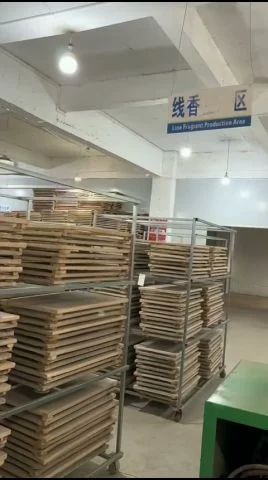
Our floor in Guangdong
Forming machinery, production trays and racks of finished sticks.
Buyer Questions
Chinese incense — frequently asked questions
Is plantation agarwood inferior to wild?
Different rather than inferior, and the distinction depends on what you are buying it for. Plantation material is more consistent, better documented and easier to import; top wild lots reach resin concentrations and profile depths that plantation material does not. For a retail programme that has to be reproducible, plantation is the correct choice.
Why does Chinese plantation material import more easily?
Because plantation source lots are traceable and the paperwork trail is straightforward. Wild-sourced consignments attract more scrutiny and more frequently get held. For EU, US and Japanese importers this shows up directly as fewer delayed containers.
Does it matter whether my lot comes from Guangdong or Hainan?
Not to the specification, and we would rather say that plainly than invent a distinction. Both provinces grow Aquilaria sinensis on our own stands under the same induction protocol, and finished goods are blended and graded to one standard rather than sold as two. The province is recorded on the lot paperwork because traceability should be complete, not because it is a price tier. If you need a single province specified for your own labelling, ask at quotation stage and we will tell you whether we can commit to it for your volume.
Can you match a batch to one I bought before?
Usually, yes — that is the main advantage of plantation material. We retain sealed reference samples of approved batches and assess new runs against them. Send us a physical sample of what you previously bought and we will tell you honestly whether we can match it.
Ordering, lead time, payment, shipping and claims are answered in full on the buyer FAQ.
Enquire about Guangdong & Hainan, China material
Origin claims should be documented rather than asserted. Ask us for chain of custody on any lot and we will send it before you order.