Service
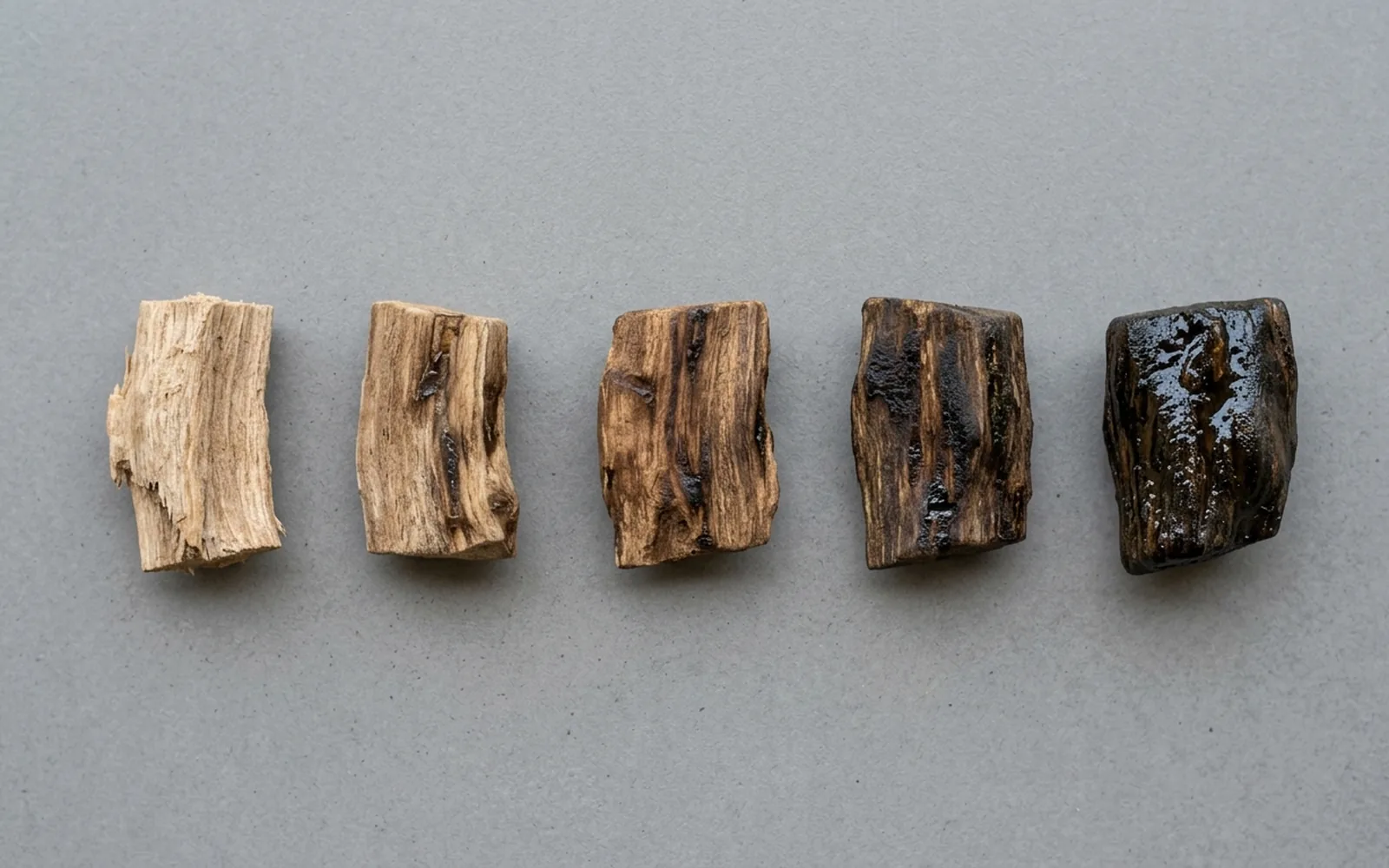
How to Identify Agarwood, and What Fake Agarwood Actually Looks Like
Verification of what you actually have, including material bought elsewhere. Sometimes the answer is that it is not what you were told.
Detail
How authentication & grading works
This category has an unusually wide gap between what is claimed and what is supplied. Most buyers have no practical way to check. We offer authentication and grading as a standalone service, including on material you bought from someone else — which we mention explicitly because it is the case where it is most needed.
For solid material and powder we assess resin content, species indicators and grade classification, with GC-MS profiling where the question is whether genuine Aquilaria is present at all. For oils, GC-MS against a reference fingerprint resolves dilution, cutting with cheaper aromatic woods, and synthetic reconstruction — none of which are reliably detectable by nose at low percentages.
We report what we find, including when it is unwelcome. A meaningful share of the material we are sent for assessment is not the grade it was sold as, and occasionally it is not agarwood in any useful sense. We would rather tell a buyer that than protect a trade relationship we have no part in.
A grading opinion from us is not a legal instrument and we do not present it as one. It is a documented technical assessment with stated methodology. That is generally sufficient for a commercial dispute, an insurance question or a decision about whether to continue with a supplier.
What we can establish and what we cannot, stated plainly before you commission anything. Analysis will tell you whether a material is agarwood, whether an oil has been diluted, cut with another botanical, or reconstructed synthetically. It will not tell you the grade, because grade is a commercial judgement about character rather than a measurable quantity. Anyone selling you a certificate that states a grade is selling you an opinion in a lab coat.
How a typical assessment runs. You send the material, we photograph and describe it on arrival. We send a small portion to an accredited laboratory under your name. The laboratory report comes back in their name rather than ours. We then read it with you and say what it does and does not support. Laboratory cost passes through at cost; our time on the reading is included.
Why we do this for material bought elsewhere. Two reasons, and only one of them is altruistic. Buyers who have been burned once tend to over-correct and stop buying the category. That is bad for everyone in it. The other reason is that a buyer who has seen what a real report looks like becomes a much easier customer to serve, because the conversation moves to specifications immediately.
What to send. For oil, two grams is enough for GC-MS and leaves a retention portion. For wood or chips, a piece rather than a photograph, because resin distribution is uneven and a photograph shows one face. Include whatever documentation came with it, even if you suspect it. The gap between what the paperwork claims and what the material is often the most informative part.
A note on cost and timing, so you can plan around it. GC-MS on an oil sample typically returns within five to eight working days once the laboratory has the material. Wood identification is faster. Neither is expensive relative to any commercial quantity of the goods in question. That is exactly why it is worth doing before the money moves rather than after.
One caveat we state upfront. A report describes the sample we sent. It does not describe the rest of a lot you have not received. That gap is closed by a sealed retention sample of the same batch, held by whoever supplied it. If there is no retention sample, the report is weaker than it looks. That is worth knowing before you rely on it.
A closing note on what to do with an unfavourable result. Decide in advance, because the decision is much harder to make honestly once the number is in front of you. You have three options and only three: return the material under whatever terms you have, sell it as what it actually is at a price that reflects that, or write it off. Reselling material you now know to be misdescribed is the one path that turns a supplier problem into your problem.
A note on chain of custody, which decides whether a report means anything later. Photograph the material on arrival before you open anything further, with any seal and lot marking visible. Keep the portion you did not send. If a dispute follows, the report plus a retained portion plus dated photographs is a position. The report alone often is not.
Process
Step by step
- Step 1
Send the material
A small sample is sufficient — 1 g on oils, 10 g on solids and powder.
- Step 2
Initial assessment
Sensory and physical evaluation against reference material.
- Step 3
Analytical work
GC-MS where the question requires it rather than by default.
- Step 4
Written report
Findings, methodology, confidence level and limitations, stated plainly.
What you receive
Deliverables
- Written assessment with stated methodology
- GC-MS profile where analytical verification is required
- Grade classification against the kōdō framework
- Species and resin-content indicators
- Clear statement of confidence and limitations
Watch
A sample presented for assessment
An agarwood oil sample in a graduated glass bottle — colour, movement and presentation.
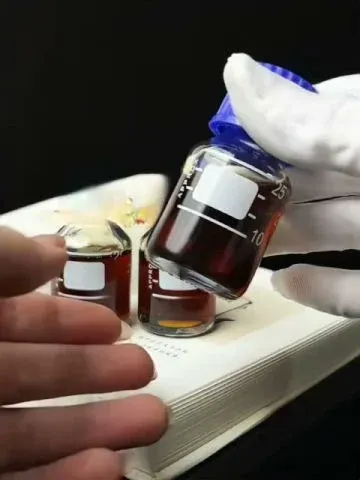
A sample presented for assessment
An agarwood oil sample in a graduated glass bottle — colour, movement and presentation.
Buyer Questions
How to identify agarwood — frequently asked questions
Will you assess material I bought from another supplier?
Yes, and that is the case where the service is most useful. We report what we find, including when the material is not the grade it was sold as — which, honestly, is a meaningful share of what gets sent to us.
Can GC-MS detect adulterated oud oil?
Yes. Dilution with carrier, cutting with cheaper aromatic woods such as sandalwood or amyris, and synthetic reconstruction all show clearly in the sesquiterpene and chromone ratios against an Aquilaria reference fingerprint, even at cut percentages a trained nose would miss.
Is your grading opinion legally binding?
No, and we do not present it as one. It is a documented technical assessment with stated methodology and limitations. That is generally sufficient for a commercial dispute, an insurance question or a decision about whether to continue with a supplier.
Ordering, lead time, payment, shipping and claims are answered in full on the buyer FAQ.
Other services
What else we handle
OEM / Private Label
Your brand on our production. Custom format, blend ratio, packaging and print, with a pre-production sample before every main run.
Sample Service
Buy a small quantity of the exact batch first. We then reserve the balance of that batch under your name for 30 days.
Export Documentation
We run the paperwork sequence so the pack is complete before the goods move. Most agarwood customs problems are paperwork problems, not product problems.
Logistics & Shipping
Air by default so a small order does not wait for a container, sea when volume makes the weeks worth it, and packing specified against the real transit risk rather than the cheapest option. Freight is quoted separately and charged to you.
Enquire about authentication & grading
Describe your situation in as much detail as you can. Specific questions get specific answers; generic enquiries get generic ones.