Real Oud Oil vs Adulterated: How to Verify What You Have Been Sent
The defence against adulterated oud is not a better nose. It is a batch number, a report and a retention sample.
Wang Jianyu
Founder & Chief Sourcing Officer
Twelve years exporting agarwood incense, powder and oud oil, working from plantation Aquilaria sinensis grown in Guangdong. Advises wholesale buyers in the Gulf, Europe and East Asia on grade selection, specification and the document set each destination needs.
There is no other natural material where the gap between the genuine article and a convincing substitute is worth this much money. A gram of good oud oil can cost more than a gram of gold, the yield from a mature tree is measured in grams. And the finished product is a dark viscous liquid that gives away almost nothing visually.
That combination explains why so much of what circulates as oud oil is diluted, cut with cheaper materials, or synthetic from end to end. It also explains why the standard defence — trusting your nose, or trusting a relationship — fails so regularly, including for people who have been in the trade for decades.
This article covers the three kinds of adulteration, what analytical testing actually detects, what to demand from a supplier, and why batch reservation matters more than most buyers realise.
How oud oil is adulterated, and what each kind leaves behind
The three kinds of adulteration
Dilution is the simplest and the most common. Genuine oud oil, extended with a neutral carrier — often a light odourless vegetable oil or a fractionated coconut oil. The product smells like oud because it is oud. There is just considerably less of it per gram than you are paying for. At 20% dilution most buyers notice nothing beyond a vague sense that the oil is not as strong as they expected.
Cutting blends genuine agarwood distillate with cheaper aromatic materials that sit close enough in profile to pass. Sandalwood and amyris are the usual choices, sometimes with a small amount of synthetic oud accord to sharpen the top. A skilled cut at 30% is not reliably detectable by nose, and the person doing the cutting knows exactly which materials sit inside the perceptual tolerance.
Synthetic reconstruction builds an oud-like accord entirely from aroma chemicals with no Aquilaria content at all. These have improved substantially over the last decade. A good one will fool most people on a paper strip; where they still fall down is in the drydown over several hours. That is precisely the test nobody performs at the point of purchase.
What each kind looks like on a report
| Type | What has been done | What the report shows |
|---|---|---|
| Dilution | Carrier oil added to genuine oud | Characteristic markers present but proportionally depressed against the carrier peak |
| Cutting | A cheaper natural oil blended in | Marker peaks from a second botanical that has no business being there |
| Reconstruction | Synthetic aroma chemicals built to imitate the profile | A short, clean list of single compounds where a natural oil shows a long tail of minor peaks |
Why the nose cannot settle it, and what can
Why a trained nose is not sufficient
This is worth stating plainly because the alternative belief is expensive. Experienced buyers routinely overestimate their ability to detect adulteration. The overestimation is structural rather than a matter of individual skill.
The reason is that oud varies enormously batch to batch even when entirely genuine. Origin, species, soak duration, distillation technique and age all shift the profile substantially — and so does how the tree itself was treated years before it was ever harvested [3]. A buyer comparing an unfamiliar sample against their internal reference has no way to distinguish "this is a different but genuine batch" from "this is a cut batch", because both produce the same perceptual signal: it does not smell quite like the last one.
Adulterators exploit exactly this. A cut oil is not presented as identical to your previous purchase. It is presented as a different origin or a different vintage, which explains the difference away before you have finished thinking about it.
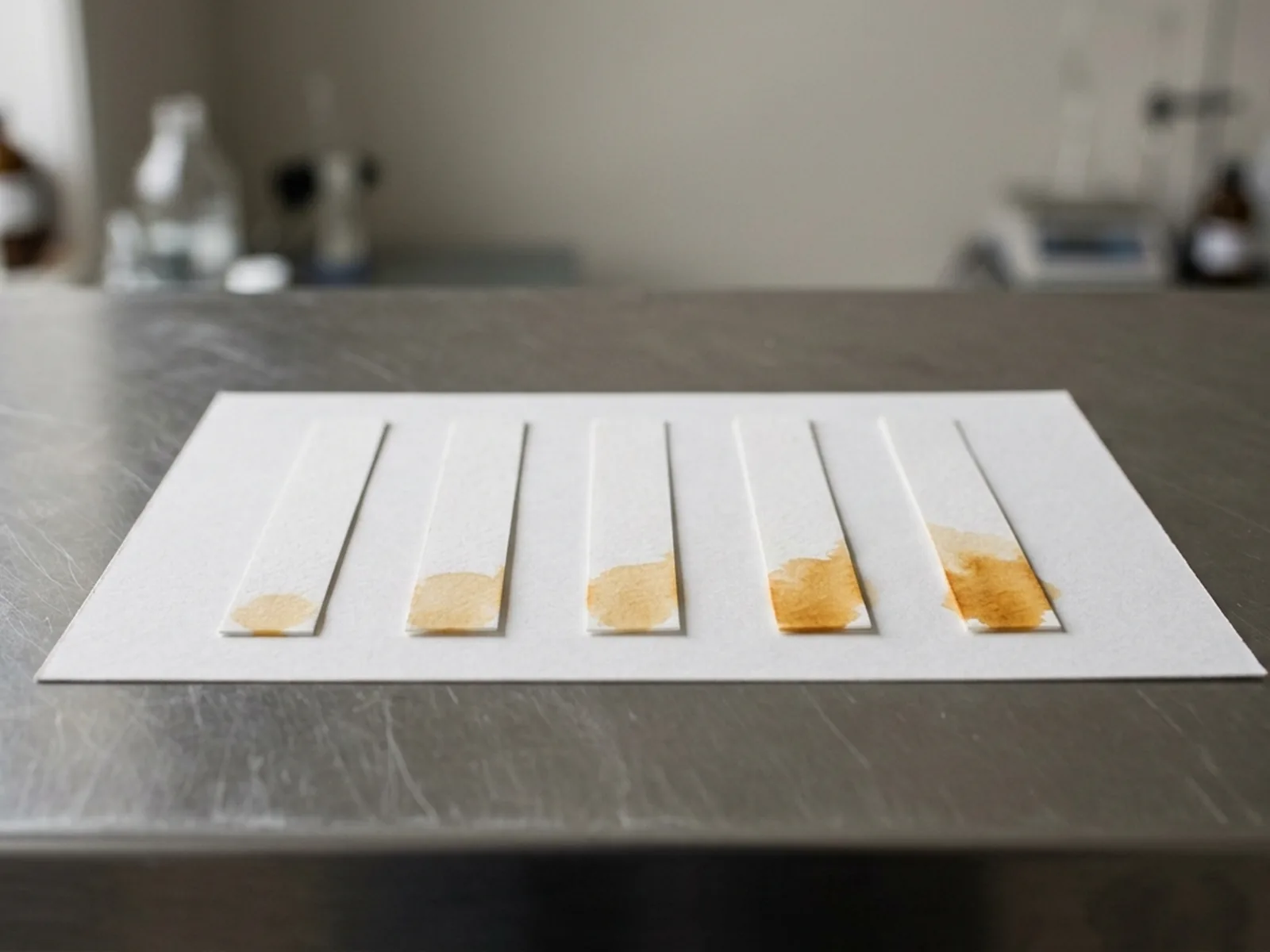
What a blotter row can and cannot tell you
What GC-MS actually shows
Gas chromatography–mass spectrometry separates a sample into its individual chemical constituents and identifies each one by mass, and it is the method the analytical literature on agarwood oil quality is built on [1]. For agarwood the relevant markers are sesquiterpenes and chromones, and genuine Aquilaria produces them in characteristic ratios [2].
Each form of adulteration leaves a distinct signature. Dilution shifts all marker concentrations downward roughly proportionally while preserving the ratios between them — a pattern that is obvious once you have a reference to compare against.
Cutting introduces markers characteristic of the other material: santalol from sandalwood, for instance, has no business appearing in an agarwood distillate. Synthetic reconstruction shows compounds that do not occur in Aquilaria at all, and typically shows an unnaturally clean profile with far fewer trace constituents than any natural distillate.
One critical detail that separates a meaningful report from a decorative one: the report must be tied to your batch number. A GC-MS profile covering a product line rather than a specific batch tells you what the supplier's oil looked like on some occasion, which in a category with this much natural variation is close to meaningless. Check what you are actually being sent.
What to demand from a supplier
Five things, and all five are reasonable requests that a legitimate supplier will meet without friction.
A GC-MS profile referenced to the batch number printed on your bottle. A sealed retention sample of that batch, held by the supplier and available for independent testing — ask how long they hold it and check that the window outlasts your own claims period and your reorder cycle, because a fixed number quoted without that comparison tells you nothing. A stated distillation date on the certificate of analysis rather than the word "aged". A paid sample of the exact batch before you commit to quantity. And a written statement of extraction method — hydro-distilled with soak duration, or supercritical CO₂.
The fourth deserves emphasis. A supplier who will not sell you a small paid sample of the specific batch you would be buying has answered a question you should have asked. There is no legitimate reason to refuse, and the refusal is more informative than any certificate.
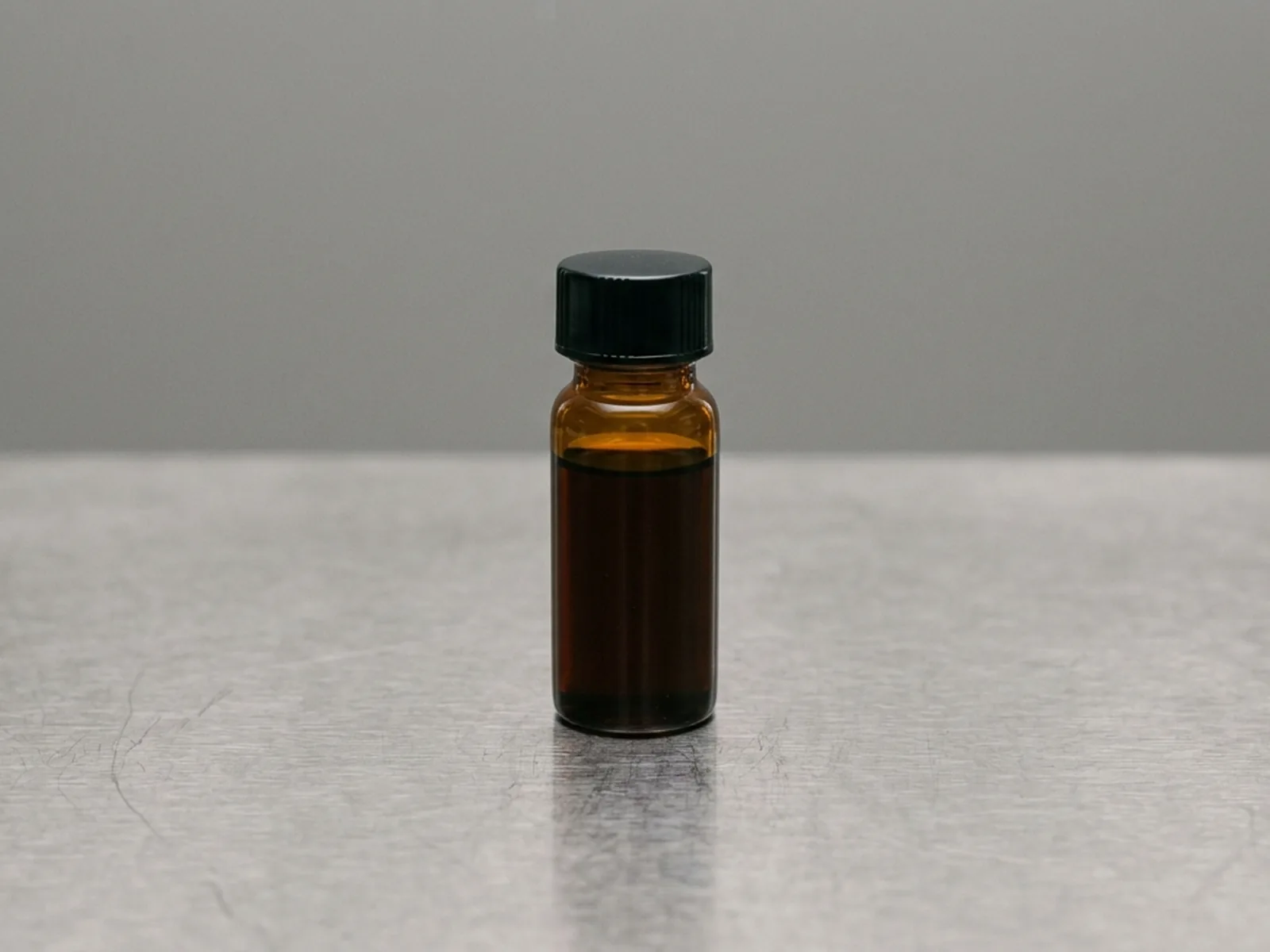
The liquid is the same; the enforceability is not
 A
AThe oil on its own tells you nothing.
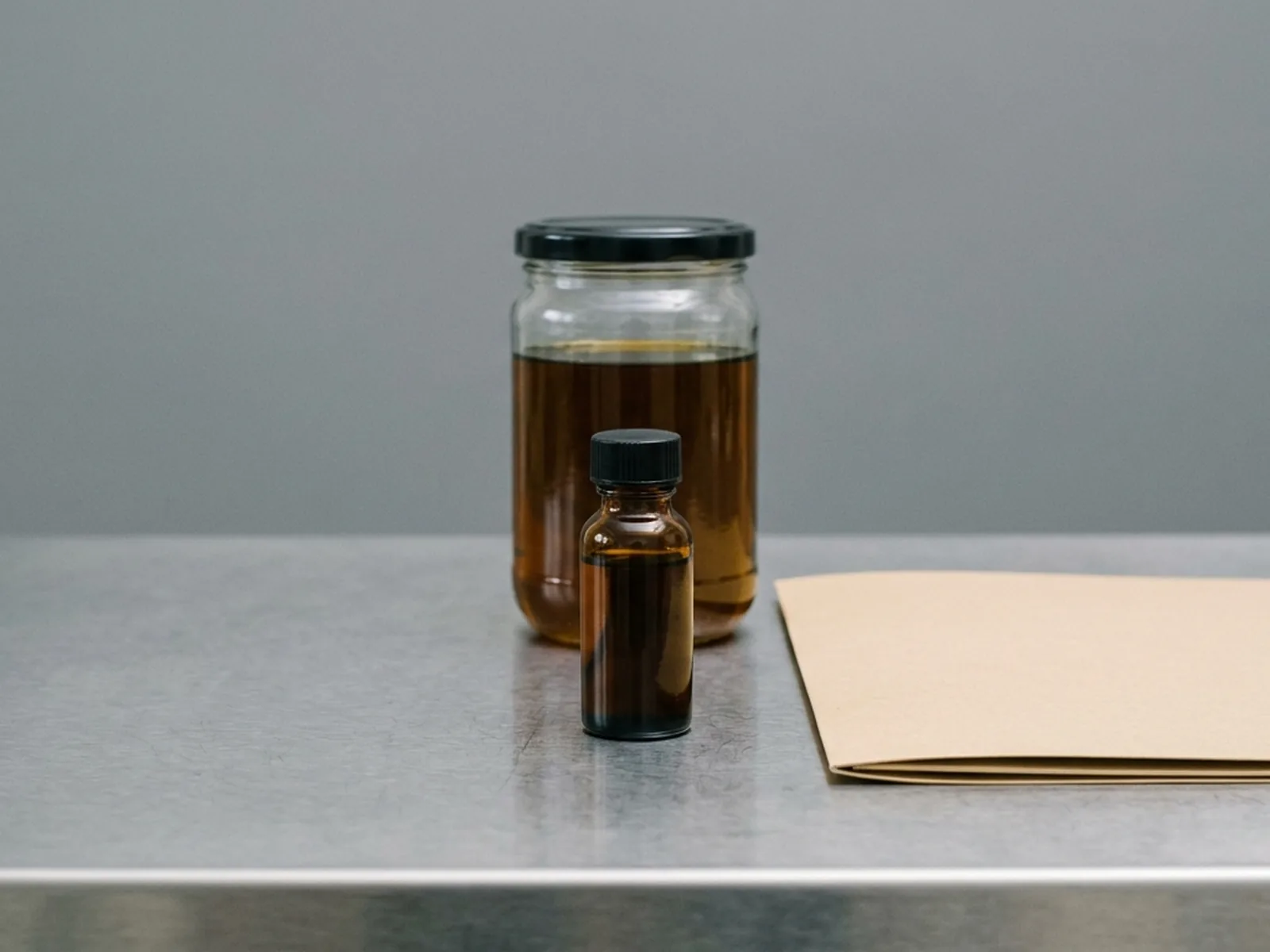 B
BSame oil, with the record and the sealed retention sample.
Why batch reservation is the mechanism that makes sampling meaningful
Here is a failure mode that catches careful buyers. You request a sample. You evaluate it properly, perhaps send it for independent testing. You approve it. Three weeks later you place a wholesale order — and receive a different batch, because the one you approved sold in the interim.
No two distillation runs are identical, so this is not a minor substitution. It voids the entire evaluation you just performed. And unless you explicitly asked, most suppliers will not think to mention it, because from their side they have shipped you the same product.
Ask whether the supplier will hold the balance of an approved batch under your name, and for how long. We reserve for 30 days at no charge. Without that mechanism, sample approval on a variable natural product is a ritual rather than a control.
Two things that look like adulteration and are not
CO₂ versus hydro-distilled: not an authenticity question
Worth clarifying because it causes confusion. A supercritical CO₂ extract smells markedly different from a traditional hydro-distilled oil — brighter, cleaner, with volatile top notes intact and none of the fermented animalic character. Buyers accustomed to dehn al oud sometimes conclude that a CO₂ extract is adulterated or synthetic on that basis.
It is not. The difference is process. Hydro-distillation begins with a soak of 1–3 weeks that ferments the wood, producing the barnyard depth the Gulf market expects, and the heat of distillation then destroys the lightest volatiles. CO₂ extraction runs cold with no soak, so the top survives and the fermentation notes never form.
Both are genuine agarwood. They are different materials for different applications, and buying the wrong one for your use case is a far more common and more expensive mistake than buying an adulterated one.
Price as a signal, and where it misleads
Buyers often use price as a proxy for authenticity, on the reasoning that nobody sells real oud cheaply. The reasoning is half right and the half that is wrong costs money.
It is true that genuine oud has a hard price floor. Yields from hydro-distillation run well under 0.1% by weight. So the raw material cost per gram of finished oil is substantial before anyone has been paid for labour, equipment or time. An offer far below that floor is arithmetically impossible as genuine undiluted material. This is a useful filter at the bottom of the market.
What the reasoning misses is that a high price proves nothing. Adulteration is most profitable precisely at the top of the market, where a 30% cut on material priced at collector rates yields more margin than selling genuine mid-grade oil honestly. Some of the most thoroughly adulterated oil in circulation is also the most expensive.
A second trap: pricing by volume rather than weight. Specific gravity varies meaningfully between batches, roughly 0.94 to 1.01, so a millilitre is not a stable unit of value. The whole trade prices by the gram for that reason. A supplier quoting in millilitres is either unfamiliar with the trade or quietly favouring themselves on a viscous batch. Neither is reassuring.
The workable position: use price as a floor filter, and use documentation for everything above the floor.
Building a supplier evaluation process you can repeat
One-off vigilance does not scale. If you buy oud regularly, the practical answer is a short standard process applied to every new supplier and every significant new batch.
Stage one, before any money moves: ask the five questions above — batch-tied GC-MS, retention sample and its duration, stated distillation date, availability of a paid sample from the exact batch, and written extraction method. Record the answers. Evasiveness at this stage is the cheapest possible disqualification.
Stage two: buy the smallest paid sample of the specific batch. Evaluate it over several hours rather than on a strip, because synthetics and heavy cuts most often reveal themselves in the drydown. If the value at stake justifies it, send a portion for independent GC-MS rather than relying solely on the supplier's report.
Stage three: confirm batch reservation in writing before you place the wholesale order, and confirm on receipt that the batch number on the bottle matches the one you approved. This takes 30 seconds and closes the most common gap in the whole process.
Stage four: keep your own retained sample of every batch you buy, sealed and labelled with the batch number. Suppliers keep retention samples to protect themselves as much as you; keeping your own means any dispute has evidence on both sides rather than one.
None of this is onerous once it is a habit. It converts oud buying from an exercise in trust into an exercise in process.
A repeatable evaluation sequence
Buy a paid sample of a specific batch
Not a generic sample. The number on the bottle is what every later step refers back to, and a sample with no batch number cannot be verified by anyone.
Ask for the batch certificate and the retention arrangement
You are checking two things: that the document exists, and that a sealed sample of the same lot is held. One without the other is not enforceable.
Commission GC-MS on the sample you hold
Independently, not from the supplier. A report authored by the party being checked answers a question about itself.
Compare the profile against the reference fingerprint
You are looking for dilution and for markers that should not be present. This is where adulteration shows up, and it is not something a nose can do.
Reserve the balance of the batch before you commit
Approval means nothing if the shipped lot is a different one. Reservation is the mechanism that makes every step above worth doing.
If you already hold oil you are unsure about
Have it tested. GC-MS on a small sample is inexpensive relative to the value of any commercial quantity of oud. It converts an uncomfortable suspicion into a fact you can act on.
We assess material for buyers including oil bought from other suppliers, and we report what we find. A meaningful share of what gets sent to us is not the grade it was sold as, and occasionally it is not agarwood in any useful sense. That is unwelcome news to deliver and it is more useful than a polite silence.
A grading and analysis report is not a legal instrument and we do not present it as one. It is a documented technical assessment with stated methodology and limitations — generally sufficient for a commercial dispute, an insurance claim, or a decision about whether to place another order with the same supplier.
Whatever the result, decide in advance what you will do with it, because that decision is much harder to make honestly once the number is in front of you. If a commissioned analysis shows the oil is cut, you have three options and only three: return it under whatever terms you have, sell it as what it actually is at a price that reflects that, or write it off.
Reselling material you now know to be misdescribed is the one path that turns a supplier problem into your problem. And it is the path most people drift into by not choosing.
For the next purchase, the sequence that prevents all of this is short enough to keep on a card. Request the batch number, request a paid sample from that batch, request the analysis for that same batch, request that the batch be reserved while you evaluate, and confirm the retention sample exists and how long it will be held.
Five requests, in that order, before any money moves for volume. A supplier who can satisfy all five has told you more about how they operate than any amount of correspondence about grade and origin.
References
- [1]Ismail N., Ali N.A.M., Jamil M., Rahiman M.H.F., Tajuddin S.N., Taib M.N.. A review study of agarwood oil and its quality analysis. Jurnal Teknologi 68, 2014.
- [2]Naef R.. The volatile and semi-volatile constituents of agarwood, the infected heartwood of Aquilaria species: a review. Flavour and Fragrance Journal 26:73–87, 2011.
- [3]Van Thanh L., Van Do T., Son N.H., Sato T., Kozan O.. Impacts of biological, chemical and mechanical treatments on sesquiterpene content in stems of planted Aquilaria crassna trees. Agroforestry Systems 89:973–981, 2015.