Sourcing Agarwood Incense for a Japanese Incense Brand
The hardest market to enter and the most durable one to hold. The bar is reproducibility, not brilliance.
Wang Jianyu
Founder & Chief Sourcing Officer
Twelve years exporting agarwood incense, powder and oud oil, working from plantation Aquilaria sinensis grown in Guangdong. Advises wholesale buyers in the Gulf, Europe and East Asia on grade selection, specification and the document set each destination needs.
Japanese incense retail applies the strictest standards in this trade. Suppliers approaching it for the first time usually understand that much, and usually misunderstand what the standards are actually about.
They are not about producing the most impressive sample. Impressive samples are easy and they are why so many suppliers win a first order and lose the account within a year. The standards are about producing the same thing next year, and the year after — and almost every operational difference between a supplier who holds a Japanese account and one who does not comes down to that.
What the specification actually is
Format is the price of entry, not a differentiator
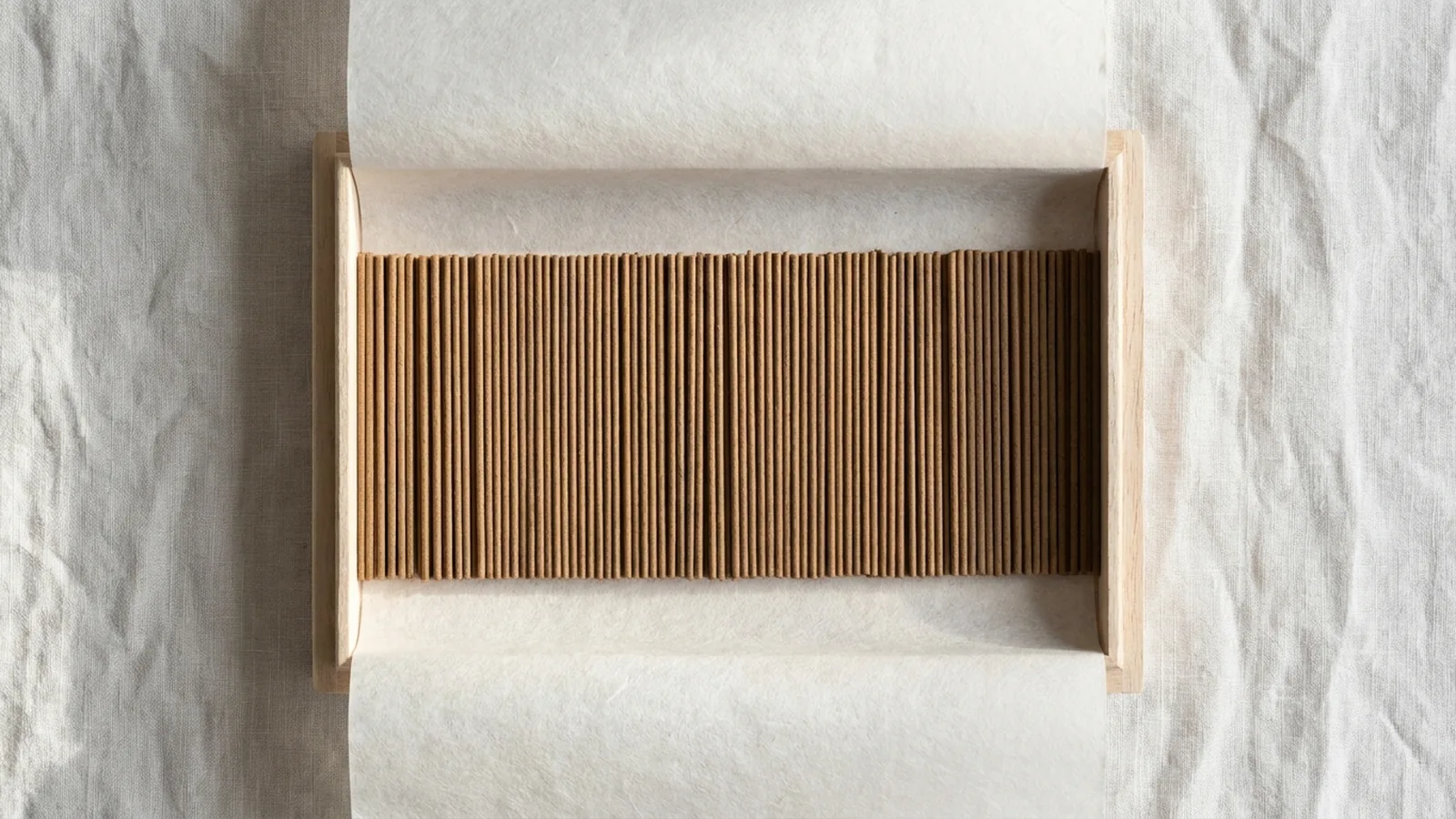
Short sticks, 10.5 cm or 13.5 cm, burning 20–30 minutes. Coreless as a matter of course. Fine diameter, typically 1.2 mm. Packaged in a rigid box rather than a sleeve.
A 21 cm cored stick reads as foreign product on a Japanese shelf regardless of the quality of the material inside it. This is not aesthetic conservatism — the formats reflect how incense is actually used there, in smaller domestic spaces, often with the user seated close to the burn, frequently to structure a defined period of time rather than to scent a room in the background.
Getting the format right buys you a hearing. It does not distinguish you, because every credible competitor has also got it right.
Why dimensional tolerance matters more here
We hold ±0.05 mm on diameter for our koh-grade line, which is the tightest tolerance we run anywhere. For context, the group standard for agarwood burning products allows ±0.15 mm on stick diameter [1]. The reason for running three times tighter than that is not perfectionism for its own sake.
Diameter variation translates directly into burn-time variation. A stick 10% thicker than its neighbour burns meaningfully longer. In most markets nobody notices. In kōdō use, where the duration of a stick often defines the length of a sitting, an inconsistent burn time is immediately apparent and reads as poor manufacture.
Ash behaviour operates the same way. Fine white ash that holds its column is expected; ash that falls early or discolours is read as a formulation shortcut. Both properties are controlled at the production stage — drying rate, binder ratio, moisture — rather than fixable afterwards.
The row tells you before the micrometer does
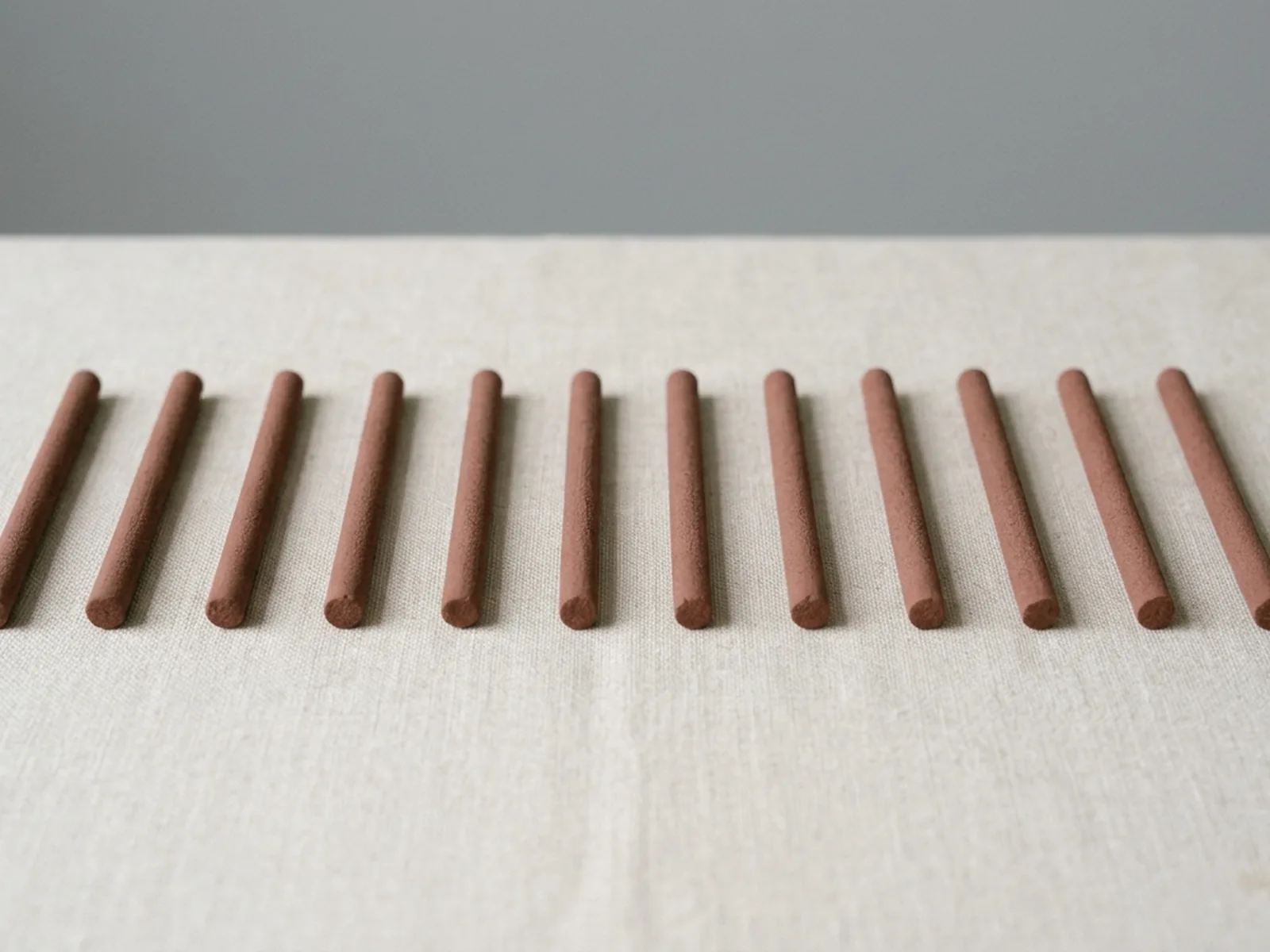 A
ACut to tolerance: the row ends straight.
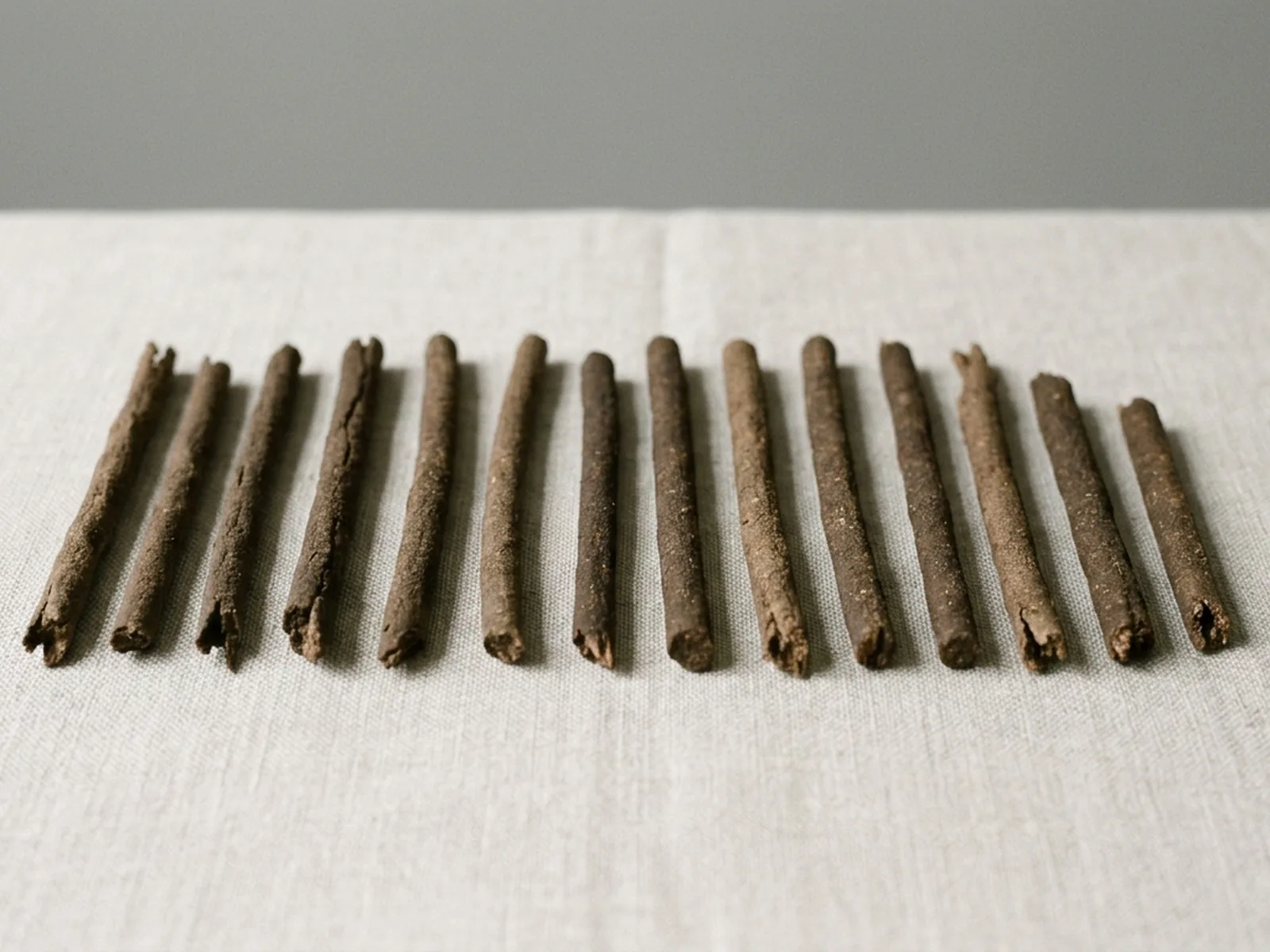 B
BNo tolerance control: length and diameter both drift.
Japanese conventions against a general specification
| Japanese incense brand | General wholesale | |
|---|---|---|
| Stick length | 9–14 cm, short format for indoor use | 20–40 cm, where visible burn time is the selling point |
| Construction | Coreless, without exception | Cored is normal and often preferred |
| Dimensional tolerance | ±0.05 mm on diameter | ±0.1 mm is accepted |
| Basis of approval | Match to a retained reference sample | Match to a written specification |
Reproducibility: the actual test
This is the requirement that separates suppliers, and it is worth describing concretely because it is an operational discipline rather than a quality claim.
A sealed reference sample of every approved batch is retained. Every subsequent production run is assessed against that reference by a trained panel before release. A run that has drifted — even a run that is arguably better — does not ship under that grade. It gets held, reworked or sold as something else.
That is slower and more expensive than normal production, because it means occasionally rejecting saleable material. It is also the only mechanism that lets a Japanese retailer build a shelf position, because a customer returning for the same box expects the same experience and the retailer cannot re-establish an SKU annually.
A practical implication for you as a buyer: ask a prospective supplier what happens to a batch that does not match the reference. The answer tells you whether the reference process exists or is described.
Plantation material is an advantage here, not a compromise
Counterintuitively for a market this quality-focused, plantation Aquilaria is often the correct choice for a Japanese programme rather than wild-band material.
The reason follows directly from the above. Wild lots are one-offs and cannot be matched to a reference and resupplied. They are excellent for a collector SKU sold as a limited release, and unusable as the base of a continuing shelf position that has to be reproducible.
Plantation source documentation is also viewed favourably and worth including even where not strictly required. It costs nothing and it positions the supply chain as traceable. That matters to buyers who are themselves answering questions about provenance.
If your range also carries wild-band or kynam, it belongs at the top, explicitly positioned as allocated and limited — a story that market understands well. It will have to come from a specialist rather than from us. Our top tier is koh grade, plantation material selected for resin fraction.
Understanding what the incense is used for
Format and tolerance requirements make more sense once you understand the use cases behind them, and understanding the use cases is what lets you propose rather than merely respond.
Daily domestic use is the volume base — a stick lit at a butsudan in the morning, or in the evening to mark the end of a working day. Short, low-smoke, consistent, and bought repeatedly. Low smoke here is a formulation property rather than a marketing line, and it sits alongside the emission limits the mandatory national standard sets for burning-incense products [2]. This is where reproducibility matters most, because it is a habitual purchase and the customer notices change immediately.
Kōdō practice is small in volume and disproportionately influential. Here the incense is listened to — monkō — with attention paid to how the note develops across the burn, a development that traces to the volatile and semi-volatile constituents the heartwood releases as it heats [3], often in a structured session where the duration of a stick defines a segment of time. This is the use case that generates the tolerance requirements, and the practitioners in it shape what specialist retailers stock.
Tea ceremony use overlaps but has its own conventions, generally favouring restraint over intensity — an incense that supports the room rather than occupying it.
Temple and religious supply is a separate channel with different economics, buying larger formats and bulk powder on consistency and price rather than presentation.
Gifting, particularly through department stores, is seasonal and presentation-led, and it is where packaging quality does most of the work. A supplier who can speak to which of these channels a product suits is having a different conversation from one presenting a range.
How to approach a Japanese buyer
How to open the conversation
Send a sample set, not a catalogue. This is the single most common mistake and it costs suppliers the first meeting.
Better: ask what the buyer currently stocks, obtain a physical sample of it, and send a matched attempt alongside two considered alternatives. Matching against material is far more reliable than matching against a written brief, and presenting a deliberate three-sample comparison demonstrates competence in a way a product list cannot.
Be specific about numbers. Binder ratio, moisture at packing, dimensional tolerance, self-extinguish rate across a stated panel size, and what happens to a batch that misses the reference. Japanese buyers respond well to specifications and poorly to adjectives. And this is one of the few markets where leading with technical detail rather than with brand story is the correct approach.
Finally, be honest about what you cannot do. If your minimum tolerance is ±0.1 mm rather than ±0.05 mm, say so. Discovering a limitation after the first order is far more damaging than declaring it before.
Entering the market, in sequence
Send a specification, not a catalogue
The first thing a Japanese buyer reads is whether you can state numbers. A range of pretty products with no tolerances reads as a supplier who has not measured anything.
Offer a paid sample from a real batch
Free samples signal that the batch is not real. Paid samples drawn from production signal the opposite, and cost you less than the enquiries you lose.
Expect a long evaluation, and do not chase
Evaluation here runs on a schedule you do not control. Following up weekly does not accelerate it; it signals that you need the order more than you need the fit.
Ship a second lot and let them compare it to the first
This is the actual test. Reproducibility cannot be demonstrated with one shipment, and everyone knows it.
Hold the specification once it is agreed
Improving the product without telling them is a failure, not a favour. The account is built on the next lot smelling like the last one.
Packaging, language and the details that get noticed
Product quality opens the conversation. Presentation decides whether a Japanese buyer treats you as a serious supplier or as a foreign factory that made a good sample.
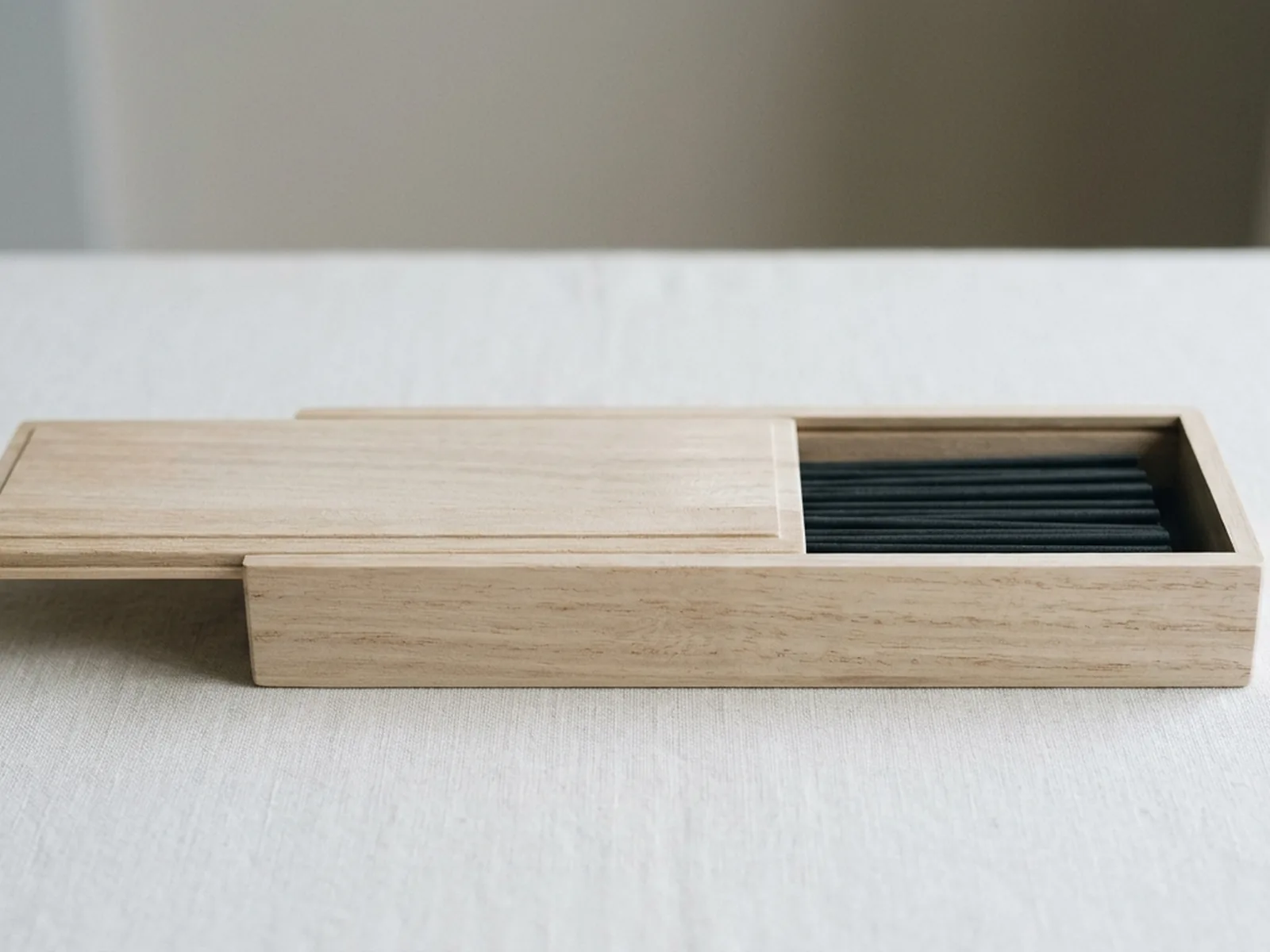
Packaging first. Rigid boxes rather than sleeves, at a standard consistent with the price point. Paulownia-style boxes are conventional at the upper end and are read as appropriate rather than as an affectation. Inner trays that hold the sticks without rattle. The box will be handled in-store by staff who assess it before the customer does.
Language second. A Japanese-language ingredient and usage panel is expected at retail and its absence is conspicuous. This is not merely translation — usage conventions differ. A panel that reads as a translated English one signals unfamiliarity. Have it written rather than converted.
Third, and easily overlooked: the paperwork that travels with the goods. Batch documentation presented cleanly, in a consistent format, shipment after shipment. Japanese buyers read documentation as an indicator of process discipline, and inconsistent formatting between shipments raises questions about what else varies.
None of these are expensive. All of them are noticed, and collectively they determine whether your second order is larger than your first.
The box is assessed before the sticks are
Timelines, and what holding the account looks like
A realistic timeline for entering the market
Suppliers routinely underestimate this and then conclude the market is closed to them, when in fact they were simply operating on the wrong clock.
Expect the first exchange to be about samples, not orders, and expect it to take several rounds. A buyer who asks for a second and third sample is engaged, not stalling. A buyer who orders immediately from a first sample is unusual and, in our experience, less likely to become a long relationship.
Expect the first order to be small — deliberately so. It is a test of whether the production matches the sample and whether the documentation and shipping behave. Treat it with the attention you would give a large one, because that is exactly what is being assessed.
Expect the second order to be the real signal. If the second batch matches the first, you are being evaluated as a continuing supplier. If it does not, the relationship generally ends there without much discussion. That is why the reference-matching discipline described above matters more than any single impressive batch.
Realistically, from first contact to a stable repeating programme is measured in quarters rather than weeks. Against that, Japanese accounts once established tend to be unusually durable and unusually low-drama. That is the commercial argument for the patience.
What holding the account looks like
Japanese accounts are slow to win and unusually durable once won. That is the commercial argument for the operational cost of serving them properly.
The maintenance obligations are ongoing: reference-matched release on every run, batch documentation with every shipment, and proactive communication when anything in the supply chain changes. If a source lot shifts and the profile will move even slightly, the correct action is to say so before shipping rather than hoping it passes.
That last habit is what actually holds accounts. A supplier who flags a small deviation before it arrives is treated as a partner. A supplier who ships and waits to see whether anyone notices gets one chance.
One thing worth budgeting for that most first-time entrants do not. Assume the first matched attempt will be rejected, and treat that as the process working rather than as a setback. The rejection almost always comes with information, and that information is more valuable than an approval would have been at that stage, because it tells you which axis the buyer is actually judging on.
Plan two sampling rounds and a 12-week runway before any commercial conversation, and price the samples into your market entry cost rather than hoping to recover them on the first order.
Then, once you are in, protect the thing that got you there. The most common way a supplier loses a Japanese account is not a bad batch. It is a good one that drifted upward, went out unremarked, and reset the customer expectation that the following batch then failed to meet.
Ask your supplier what their retained reference sample is, how often it is renewed, and what happens to a run that no longer matches it. If the answer is that a better-than-reference run ships anyway, you have found the failure mode before it finds you.
Finally, a word about how long this takes, because the timeline is the part most entrants get wrong rather than the specification. From first contact to a repeating order is commonly 9–12 months in this market. The middle of that period looks like nothing happening.
It is not. It is the buyer establishing that you are still there, still consistent, and still answering the same way about the same questions. Suppliers who read that quiet period as disinterest and start discounting are the ones who do not make it through it. Hold your specification, and answer the tenth enquiry at the same speed you answered the first.
References
- [1]Hainan Agarwood Industry Association. T/HAIUA 001-2024 — Agarwood burning products. Group standard (voluntary), 2024.
- [2]Standardization Administration of the PRC. GB 26386 — Safety technical requirements for burning incense products. Mandatory national standard (PRC), 2011.
- [3]Naef R.. The volatile and semi-volatile constituents of agarwood, the infected heartwood of Aquilaria species: a review. Flavour and Fragrance Journal 26:73–87, 2011.