
Meditation Incense: What the Mindfulness Channel Actually Specifies
The buyers in this channel are unusually specific about smoke, burn time and ash, and unusually vague about scent. That combination catches suppliers who prepare for the wrong conversation.
Wang Jianyu
Founder & Chief Sourcing Officer
Twelve years exporting agarwood incense, powder and oud oil, working from plantation Aquilaria sinensis grown in Guangdong. Advises wholesale buyers in the Gulf, Europe and East Asia on grade selection, specification and the document set each destination needs.
Meditation incense is not a fragrance category. It is a channel, and the buyers in it specify differently from every other incense customer you will deal with.
The pattern catches suppliers out because it runs opposite to expectations. These buyers are unusually precise about smoke volume, burn duration and how the ash behaves, and unusually loose about scent, often accepting a range where a Gulf or Japanese buyer would not. A supplier who arrives ready to discuss aromatic character and has no numbers for the other three is having the wrong conversation.
This article covers who is actually buying, what sits behind the words they use, where products fail in this channel, and how to turn any of it into something a factory can hold to.
Who actually buys meditation incense
Four channels that look like one
From a distance this looks like a single wellness market. In purchasing terms it is at least four, and they want different things from the same shelf.
Studios and practice spaces buy on consistency and burn time, in volume, with almost no interest in packaging. Wellness and lifestyle retail buys on presentation and story, in smaller quantities at higher margin. Subscription boxes buy on unit cost and on the ability to ship flat. Practitioners and teachers buy small quantities repeatedly and are the most sensitive of the four to a batch that has changed.
The mistake is to build one product for all four. The studio account will not pay for the retail box, and the retail account will not accept the studio product on a shelf.
The ordering rhythms differ as much as the specifications. Studios reorder predictably and in volume once they have settled on something, which makes them the best base load and the least tolerant of a batch that moved. Retail orders seasonally and in smaller quantities, so a profile change is less likely to be noticed but a packaging failure is fatal. Subscription boxes order in large single drops against a date they cannot move, which turns lead time into the binding constraint rather than price. Ask which rhythm you are being asked to serve before you quote, because it changes what the quote should protect against.
What each one is really buying
| Buyer | Buys on | Will reject over | Format that suits |
|---|---|---|---|
| Studios and practice spaces | Burn time, low smoke, price per stick | Smoke in a closed room, sticks that go out | Short to mid length, plain bulk packing |
| Wellness and lifestyle retail | Presentation, story, shelf appeal | A box that looks cheap beside its neighbours | Rigid box, printed panel, matching holder |
| Subscription boxes | Unit cost, flat pack, breakage rate | Anything that arrives snapped | Short sticks, trayed, slim carton |
| Practitioners and teachers | The batch smelling like the last one | A profile that moved without warning | Small repeat quantities against a reference |
The specification behind the word calm
Smoke, burn time and ash
Buyers in this channel say calm, clean and gentle. Underneath those words sit three properties that can be measured and therefore specified.
Smoke volume comes first, because the product is burned in a small room with people seated close to it and often with the windows shut. Smoke density is a formulation outcome rather than a marketing line: it tracks binder ratio, moisture at packing, and whether anything in the blend is subsidising the burn. It also sits alongside the emission limits that the mandatory national standard sets for burning-incense products, which apply regardless of which market the goods go to [1].
Ash behaviour comes second and is more visible than most suppliers expect. A stick that holds a fine pale ash column reads as well made; one that drops ash early or discolours reads as a shortcut, and in this channel the product is being looked at for the whole burn rather than glanced at.
Why burn time is the requirement nobody writes down
The defining use in this channel is that the stick marks a period of time. A session is bounded by it, which means burn duration is not a nice-to-have specification, it is the product function.
That makes variation in burn time the complaint most likely to lose the account, and it is a physical property rather than an aromatic one. Duration follows diameter, binder ratio and moisture at packing, so it drifts whenever any of those drift. Diameter is the one with a published reference to work against: the group standard for agarwood burning products sets stick diameters at 1.5, 1.8, 2.0 and 3.0 mm with a tolerance of ±0.15 mm, and lengths at 105 ±10 and 210 ±10 mm [2].
Specify a target duration with a tolerance, against stated ambient conditions, and ask what the supplier does with a run that falls outside it. A burn time quoted without conditions is a description rather than a specification, and it cannot be the basis of a rejection.
Where products fail in this channel
The three complaints that come back
Self-extinguishing is first and the most damaging, because a stick that goes out during a session fails at the exact moment the customer is paying attention. It is usually a binder ratio problem or a moisture problem, and both are supplier-side and fixable.
Visible smoke is second. A product that reads as acceptable in a showroom can be intolerable in a small studio with ten people in it, which is why sampling in this channel has to happen in a room like the one the product will be used in.
A changed batch is third and the one that ends relationships. Practitioners notice, because they burn the same product daily. A supplier who flags a source-lot change before shipping is treated as a partner; one who ships and waits to see whether anyone notices gets one chance.
There is a fourth that is easy to misdiagnose. Complaints that arrive in clusters from one region, in one season, are usually a storage problem rather than a production one — incense picks up moisture in a humid warehouse and burns slower, smokier and less reliably as a result. Before you rework a formulation, check whether the failures share a destination and a month. If they do, the fix is packaging and stock rotation at the customer end, and reformulating will make the product worse everywhere else.
Where the product is actually used
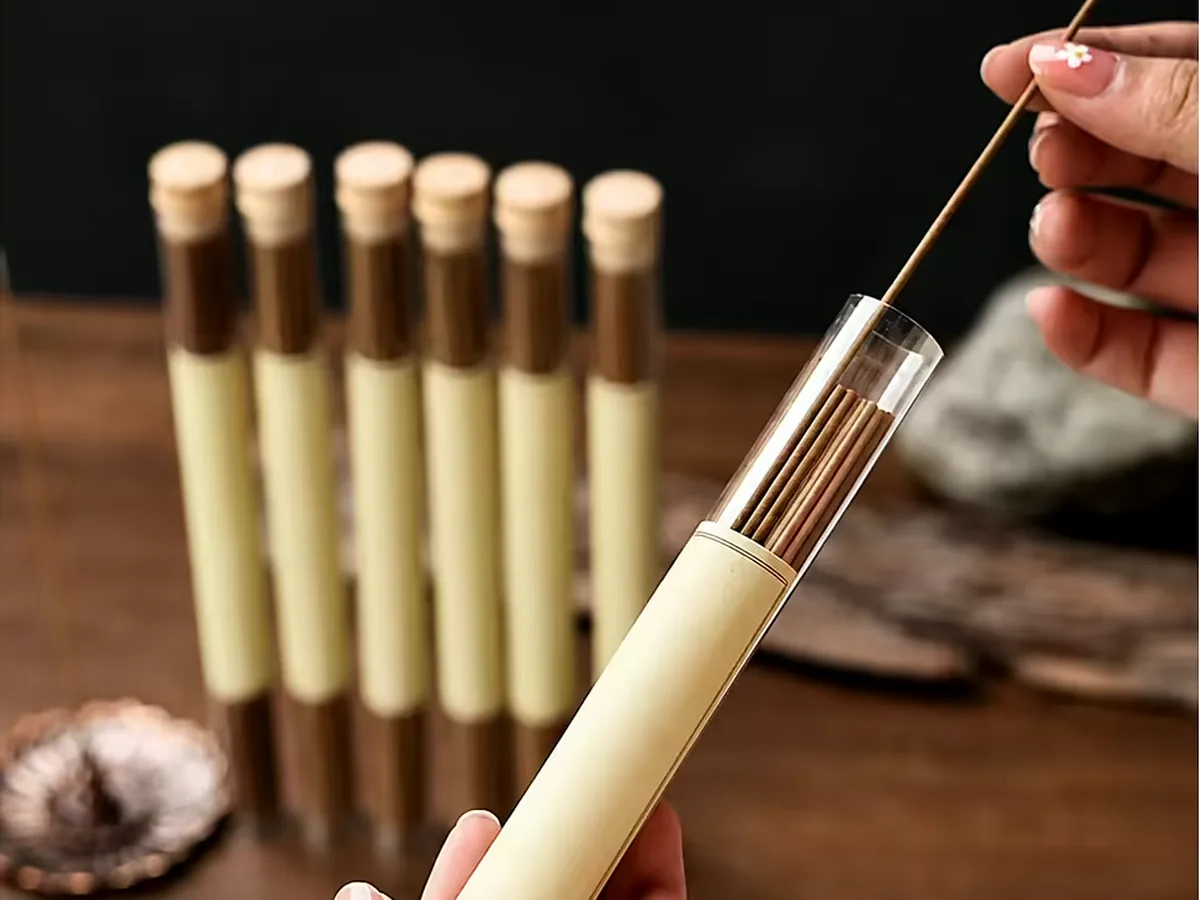
Materials the channel will and will not accept
Agarwood in a category dominated by cheaper botanicals
Most of this shelf is not agarwood. It is sandalwood, resins and blended botanicals at a fraction of the material cost, which sets the price expectation your product has to argue with.
The argument that works is not that agarwood is better in the abstract. It is that the properties this channel already asks for are consequences of resin content: an aromatic profile carried by the material rather than by added fragrance oil behaves differently across a burn, and the difference shows up in the last third where a customer paying attention will meet it.
What agarwood does not do is compete on price per stick against a botanical blend, and pretending otherwise wastes both parties a sampling round. Position it at the top of a range, and let the entry tier be something else.
The practical version of that is a two-tier shelf rather than a single hero product. An entry line the customer buys weekly, and one agarwood line above it that a customer trades up to and then keeps buying, is a structure this channel understands, because it mirrors how its customers already buy tea and coffee. A single expensive product with nothing beneath it reads as an outlier and gets picked up, examined and put back.
Additives, and the questions you will be asked
This channel asks about ingredients more than any other, and the questions are specific: what the binder is, whether there is charcoal, whether fragrance oil has been added, and what the stick is made of if it has a core.
Have the answers written down before the first enquiry. Natural makko is powdered bark from the Machilus thunbergii tree, and naming it by botanical name answers the question in a way that a phrase like natural binder does not. If the product is coreless, say so; if it has a bamboo core, say that too, because the core burns alongside the aromatic material and a buyer in this channel is likely to notice the difference in the final third.
What matters here is that every answer is checkable. Do not answer an ingredient question with a benefit. Answer it with the ingredient.
Getting it onto a purchase order
What to state, and in what units
Six lines cover almost everything this channel cares about: length and diameter with tolerances, binder type and percentage, moisture at packing, target burn time with ambient conditions stated, smoke density against a named reference stick, and construction stated explicitly as coreless or cored.
Smoke density is the line most often left as an adjective, and it is the one worth fixing. Light and heavy cannot be held to; a named reference stick can. Send one, keep one, and write the comparison into the order.
Everything else in this category — the scent description, the story, the packaging — sits on top of those six lines. None of it survives a product that goes out halfway through a session.
The order in which to settle it
Decide which of the four buyers you are serving
A studio product and a retail product diverge at the first decision. Building one and hoping it covers both produces something neither will take.
Fix burn time and length before scent
Duration is the product function in this channel. Scent can be adjusted inside a fixed geometry; geometry cannot be adjusted around a finished scent without changing the duration.
Sample in the room it will be used in
Smoke that reads as acceptable in a showroom can be intolerable in a small closed studio. This is the single most skipped step and the most common cause of a rejected second order.
Agree the reference stick, in writing, both sides holding one
This is what converts smoke density and profile from adjectives into something a batch can fail. Without it there is nothing to reject against.
Ask what happens to a run that misses the reference
The answer tells you whether the reference process exists or is merely described. If a better-than-reference run ships anyway, your customers will meet the drift before you do.
Packaging and presentation for this channel
What the box has to do
Retail in this channel sells on a shelf where every neighbour is making a similar visual argument, so the box is doing competitive work rather than protective work alone. A rigid box with an inner tray that stops the sticks rattling reads as considered; a printed sleeve reads as commodity, whatever is inside it.
The ingredient and usage panel matters more here than elsewhere, because this customer reads it. Name the binder, state the construction, give the burn time with the conditions it was measured under, and do not put a claim on the panel that you would not want to be asked to substantiate.
A matching holder sold alongside is the cheapest way to lift the basket, and it removes a friction point: a coreless stick has no bare tail to push into a conventional narrow-hole holder, and a customer who discovers that at home is a customer with a complaint.
Refills, and why they matter here
Consumption in this channel is daily and repetitive, which makes it one of the few incense categories where a refill format genuinely changes the economics. A customer who bought the presentation box once will buy the refill repeatedly, and the refill has none of the packaging cost.
It also creates the reorder rhythm that makes reference-matched production worth running. A product bought once a year does not reward batch consistency; a product bought monthly punishes the absence of it, and rewards a supplier who can hold a profile.
If you carry one thing beyond the initial box, carry the refill, and make sure the refill and the box come from the same reference batch. A customer who notices the refill smells different from the box they bought last month has learned something about the supply chain that no amount of copy will unlearn [3].
References
- [1]Standardization Administration of the PRC. GB 26386 — Safety technical requirements for burning incense products. Mandatory national standard (PRC), 2011.
- [2]Hainan Agarwood Industry Association. T/HAIUA 001-2024 — Agarwood burning products. Group standard (voluntary), 2024.
- [3]Naef R.. The volatile and semi-volatile constituents of agarwood, the infected heartwood of Aquilaria species: a review. Flavour and Fragrance Journal 26:73–87, 2011.