Why Does My Incense Keep Going Out? Black Smoke and Self-Extinguishing, Explained
Two complaints dominate incense returns, and neither is caused by the agarwood. Both are process problems with measurable fixes.
Wang Jianyu
Founder & Chief Sourcing Officer
Twelve years exporting agarwood incense, powder and oud oil, working from plantation Aquilaria sinensis grown in Guangdong. Advises wholesale buyers in the Gulf, Europe and East Asia on grade selection, specification and the document set each destination needs.
If you sell incense at any meaningful volume, two complaints will dominate your returns and your negative reviews. It produces black smoke. Or it goes out halfway through the burn.
Both get reported to you as quality problems with the agarwood. Neither one is. Both are formulation and handling problems with specific, measurable causes and specific, measurable fixes — and understanding them changes what you specify on your next purchase order.
What the two complaints actually are
Black smoke: charcoal, and to a lesser extent over-oiling
Visible black or dark grey particulate is almost always charcoal in the blend. Charcoal is added to incense for two reasons: it makes the stick burn faster and hotter, which shortens production drying time and guarantees ignition. And it is cheap, which holds down unit cost on a product where the aromatic material is expensive.
It is also, by a wide margin, the largest contributor to particulate load [1]. Charcoal combusts incompletely at the temperatures a burning incense stick reaches. The unburned carbon is what your customer sees settling on a light-coloured wall.
The secondary cause is over-oiling — a blend carrying more fragrance oil than the base material can absorb. The excess does not volatilise cleanly; it combusts, producing both particulate and a harsh top note [2]. This is most common on cheap dipped sticks where fragrance oil is doing all the aromatic work — the resin content of the base material is what decides whether a blend needs that crutch, and it varies with how the tree was treated [4]. It is essentially absent from products built on genuine agarwood powder.
The fix is formulation, and it costs something. Remove the charcoal and the burn slows, which means more material burned per minute of fragrance and a higher cost per stick. That is the entire trade, and it is why low-smoke product carries a real premium rather than a marketing one. Our low-smoke line runs no charcoal at all and tests at roughly 60% below a charcoal-bound reference stick on particulate density.
Self-extinguishing: binder ratio, then moisture
A stick that goes out mid-burn has one of two problems. Too much binder, or too much water.
On binder: makko is both adhesive and fuel, but above roughly 22% of the blend it stops sustaining a flame front reliably. The stick becomes mechanically strong and combustively weak. Below roughly 18% the opposite problem appears — the sticks burn well and break in the box. Our production sits in that 18–22% window and we state the actual figure per batch.
On moisture: agarwood powder is hygroscopic, meaning it actively absorbs water from ambient air. A stick that was blended perfectly and then absorbed humidity in a warehouse, a shipping container or an open retail display will self-extinguish regardless of how good the formulation was. This is the more common of the two causes and it is the one most often misdiagnosed as a manufacturing fault.
We dry before packing and ship desiccant in every master carton. We do not publish a moisture percentage of our own: we do not own a meter, and a number with no record behind it is not a specification. What we can tell you is that the material keeps absorbing after it leaves us — which is why the storage guidance below matters at least as much as anything printed on a certificate.
Diagnosing which problem you actually have
Read the ash first
Look at the ash first. It tells you more than anything else and it costs nothing to check.
Fine grey-white ash that holds its column for 20–30 mm before falling indicates a makko-bound stick burning correctly. Black, crumbly ash that collapses immediately indicates charcoal. Grey ash with visible black flecks indicates a partial charcoal blend, which some suppliers use to split the difference on cost.
For self-extinguishing, the diagnostic question is whether the failure is consistent. If every stick from a box goes out at roughly the same point, suspect binder ratio and ask your supplier for the number. If some sticks fail and others do not, suspect moisture — uptake is uneven across a box, with sticks nearest the opening absorbing fastest.
A third check: weigh a stick, leave it uncovered in the retail environment for 48 hours, and weigh it again. A measurable gain confirms a humidity problem in your storage rather than a formulation problem in ours.
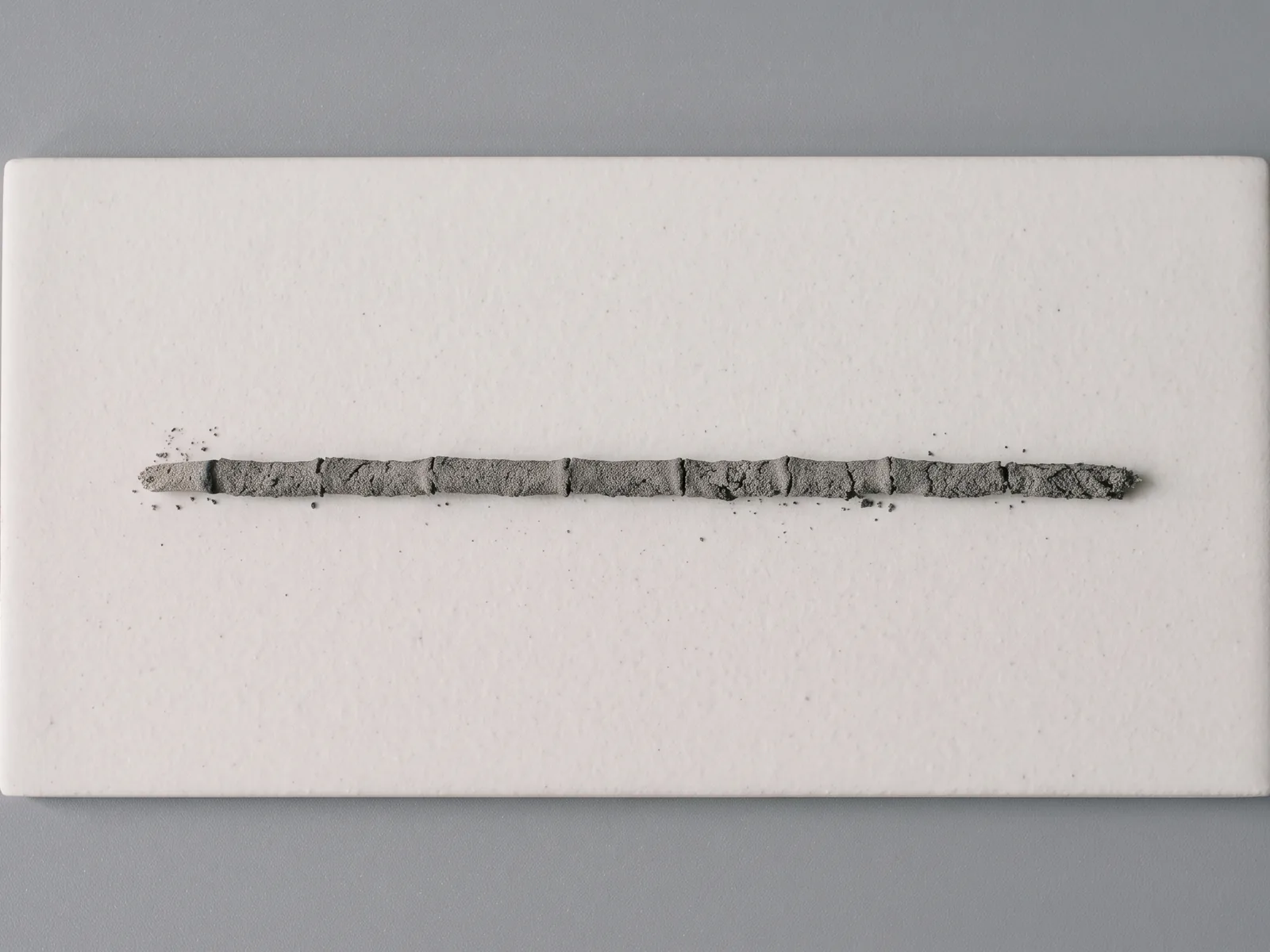 A
ABurned through: ash column intact to the end.
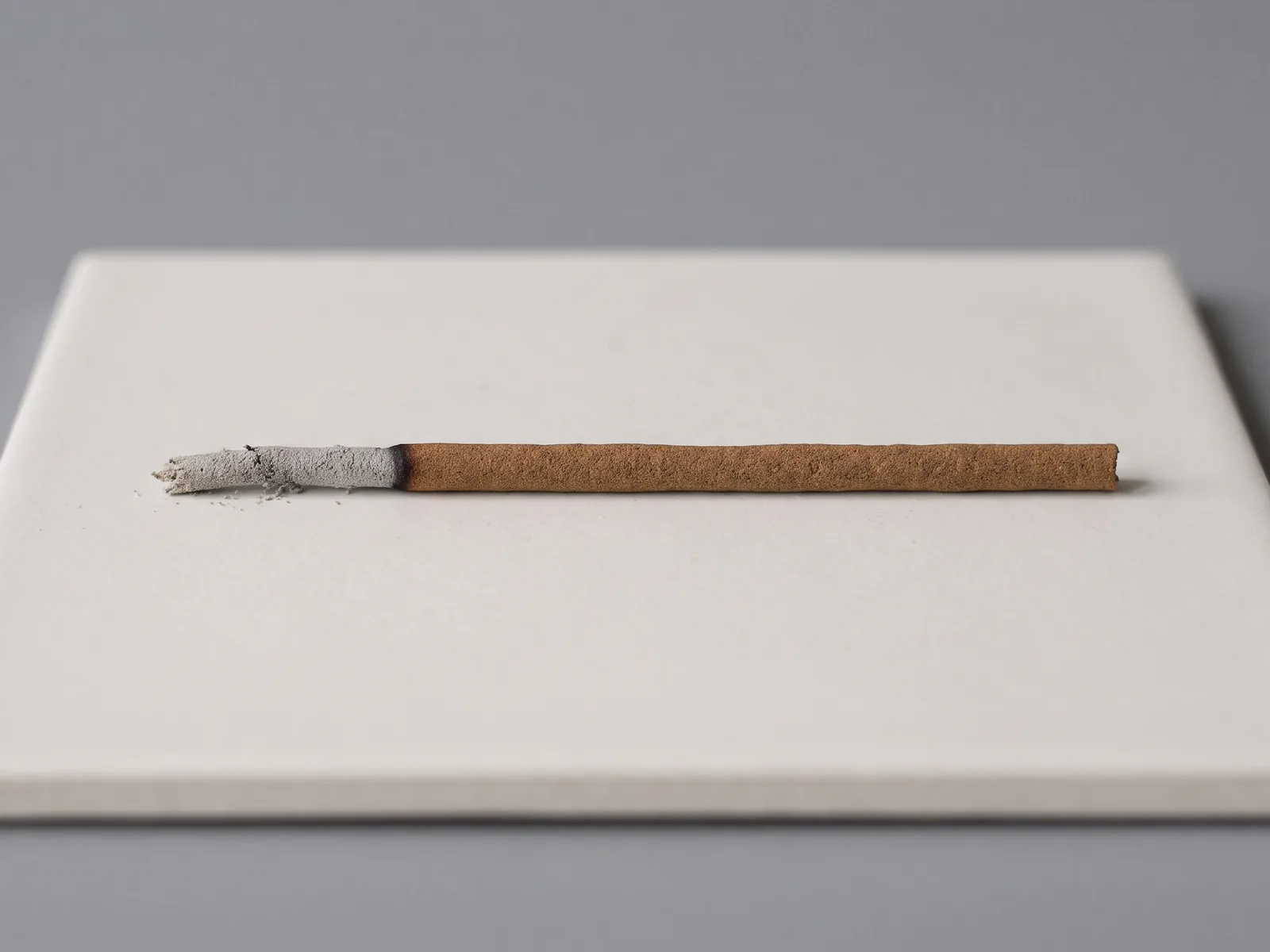 B
BSelf-extinguished: the burn line is where it stopped.
Symptom, cause and the check that confirms it
| What you see | Most likely cause | How to confirm it |
|---|---|---|
| Dense black smoke from the first minute | Charcoal in the blend | Break a stick. Charcoal shows as a uniform matte black core, not the grain of milled wood |
| Black smoke only near the base | Over-oiling during dipping | The lower third feels tacky and leaves residue on your fingers |
| Goes out within the first centimetre | Binder ratio too high | The ash crumbles to powder instead of holding a column |
| Goes out midway, mostly in humid weather | Moisture picked up in storage | Weigh a stick, dry it, weigh it again. A swing above 8% points here |
| Goes out only in the final third | The bamboo core is drawing heat away | A coreless stick from the same blend burns through |
Step by step
Diagnosing a complaint, step by step
Get the batch number before anything else
Without it you are debugging a category rather than a lot. Every step below is worth doing only against a specific batch you can go back to.
Burn three sticks from the same carton together
One stick tells you nothing — variation within a carton is what you are trying to measure. Lit side by side, differences that are invisible one at a time become obvious.
Look at the smoke colour first
Dark smoke points at the formulation side: charcoal content, or oil loading above what the body can carry. This is a supplier conversation, not a storage one.
Then look at where the burn stopped
A clean blunt burn line partway down is the self-extinguish signature. That points at binder ratio first and moisture second — in that order, because binder is fixed at manufacture and moisture is not.
Check storage before you raise a claim
Humid transit and humid retail both push moisture up after dispatch. If the retention sample burns correctly and your stock does not, the problem arrived after the goods did.
Handling it in the field: storage, complaints and the core variable
Storage and merchandising in humid markets
This matters most in Southeast Asia, the Gulf during humid months, and coastal retail anywhere. Ambient conditions in these markets will take an opened box damp enough to self-extinguish within days.
Three pieces of guidance to pass to retail customers. Keep the box closed between uses rather than leaving it open on a shelf. Do not store incense in a bathroom or kitchen, which is where a surprising number of people keep it. And if a stick does self-extinguish, letting the box sit sealed with the supplied desiccant for a few days will often restore it.
For your own warehouse: keep master cartons sealed until the stock is needed, and do not break a carton down into open display stock further ahead than you need to. This single piece of operational discipline prevents most self-extinguishing complaints in humid markets and costs nothing.
Handling complaints without conceding a fault you do not have
A practical note for retailers, because how you respond to these two complaints determines whether they cost you a customer or earn you one.
For smoke complaints, the useful first question is what the customer expected. A person who bought a 30 cm Arabic stick and burned it in a studio apartment has a product-selection problem, not a quality problem. And the correct response is an exchange for the low-smoke line rather than a refund and an apology. Framing it as "that format is built to carry a large room — this one is built for yours" converts a complaint into a second sale.
For self-extinguishing, ask where the box has been kept. Bathrooms, kitchens and open shelves near a window account for a large share of these reports. The remedy — seal the box with the desiccant and leave it a few days — usually works, costs nothing, and demonstrates that you understand the product rather than simply processing a return.
What not to do is concede a manufacturing fault reflexively. If your incoming checks were clean and your storage is controlled, the problem is downstream, and treating every complaint as a product defect trains customers to expect refunds and leaves you without data about what is actually happening.
Do track it, though. If self-extinguishing reports cluster around one batch number rather than distributing randomly, that is a genuine signal and it is worth raising with your supplier against the batch certificate.
The bamboo core variable
Worth flagging because it produces a related complaint that is neither of the two above: a stick that smells fine for two-thirds of the burn and then turns dry and papery.
That is the bamboo core burning. In a cored stick the skewer combusts alongside the aromatic material, and as the surrounding paste thins in the final third the bamboo becomes the dominant note. It reads to a customer as the incense "going off" and it is a structural property of the product rather than a defect.
If you are getting this complaint specifically, the answer is coreless product rather than a reformulation. It costs more, it is more fragile in transit. It eliminates the failure entirely because nothing burns except agarwood and binder.
Running an incoming-goods check yourself
You do not need a laboratory to catch most problems. A 20-minute check on arrival will identify the great majority of issues while the shipment is still disputable. It is worth building into your goods-in process.
Take 5 sticks at random from 3 different boxes — not from the same box, because moisture and blending variation cluster. Burn each one completely in a still room with a light-coloured surface behind it, and record four things.
Total burn time, timed. Compare against the specification; a deviation beyond about 15% suggests a diameter or binder problem. Smoke appearance against the light background: pale grey is correct, visible dark particulate is charcoal. Ash colour and column retention, measured roughly with a ruler — grey-white ash holding 20–30 mm is the target. And whether any stick self-extinguishes, which at a 5-stick sample means you should immediately test twenty more.
Then a moisture proxy: weigh a stick to two decimal places, leave it in your normal storage environment uncovered for 48 hours, and reweigh. A gain above roughly 2% tells you your storage will cause self-extinguishing complaints regardless of how the goods arrived.
Record the results against the batch number. Two or three shipments of this data gives you a baseline, and a deviation from your own baseline is far more actionable than a deviation from a supplier's specification sheet.
What a supplier-side QC panel should look like
For context on what you are entitled to ask for, here is the panel we run before any stick batch is released, and the reasoning behind each element.
Burn rate in millimetres per minute at a stated temperature and humidity, because burn rate quoted without ambient conditions is not a specification [3]. Smoke density measured against a named reference stick rather than described adjectivally. Ash behaviour, recorded as column retention distance. Self-extinguish rate across a 500-stick panel — a panel of ten tells you nothing at a failure rate of 1%. Dimensional tolerance on diameter and length. Moisture at packing.
On plantation grades there is an additional step: the batch is assessed against a sealed retained reference sample of the approved profile by a trained panel. And a run that has drifted does not ship under that grade. This is what makes reordering meaningful, and it is the specific discipline that separates suppliers who hold long-term retail accounts from suppliers who win single orders.
Ask any prospective supplier what happens to a batch that fails the panel. The answer distinguishes a process that exists from a process that is described.
What to specify on your next purchase order
The point of all of the above is that these are measurable properties, not matters of opinion. A supplier who states them can be held to them. A supplier who describes their product only as "premium" and "natural" cannot be held to anything when a shipment disappoints.
Specify six things. Binder ratio, as a percentage. Charcoal content, explicitly, even when the expected answer is none. Moisture at packing, as a percentage. Self-extinguish rate across a stated QC panel size. Smoke density, measured against a named reference. Dimensional tolerance on diameter.
Then ask for the batch certificate of analysis showing the actual measured values for your batch rather than nominal figures copied from a product-line specification. And ask whether a sealed retention sample of your batch is held, and for how long — because that is what converts every number above from a claim into something you can enforce.
One more line worth adding, because it converts everything above into something enforceable. Ask for the moisture figure and the binder percentage to be printed on the batch certificate that ships with the goods, not quoted in an email during negotiation.
An email is a claim about a product line. A certificate is a claim about the cartons in front of you, and only one of those is any use when a customer in a humid market tells you that half the box will not stay lit.
And set your own incoming check before you need it rather than after. Burn 3 sticks from 3 different cartons of every arriving shipment, photograph the ash column, and keep the photographs against the batch number. It takes ten minutes per delivery.
The value is not in catching a bad batch, which is rare. It is that when a complaint arrives eight weeks later you can tell in 30 seconds whether the goods left here that way or arrived that way. That is the difference between a conversation and an argument.
References
- [1]Standardization Administration of the PRC. GB 26386 — Safety technical requirements for burning incense products. Mandatory national standard (PRC), 2011.
- [2]Naef R.. The volatile and semi-volatile constituents of agarwood, the infected heartwood of Aquilaria species: a review. Flavour and Fragrance Journal 26:73–87, 2011.
- [3]Hainan Agarwood Industry Association. T/HAIUA 001-2024 — Agarwood burning products. Group standard (voluntary), 2024.
- [4]Van Thanh L., Van Do T., Son N.H., Sato T., Kozan O.. Impacts of biological, chemical and mechanical treatments on sesquiterpene content in stems of planted Aquilaria crassna trees. Agroforestry Systems 89:973–981, 2015.