Incense Sticks Without Bamboo vs Bamboo-Core: Which to Source for Which Market
The most consequential structural decision in incense sourcing, and the one most buyers never explicitly make.
Wang Jianyu
Founder & Chief Sourcing Officer
Twelve years exporting agarwood incense, powder and oud oil, working from plantation Aquilaria sinensis grown in Guangdong. Advises wholesale buyers in the Gulf, Europe and East Asia on grade selection, specification and the document set each destination needs.
Before grade, before origin, before blend ratio, there is a structural question that determines more about the finished product than anything else on a specification sheet: does the stick have a bamboo core?
Most buyers never explicitly decide this. They receive samples, choose one, and inherit whatever construction the supplier happened to quote. That is a mistake, because the two constructions produce measurably different products with different costs, different failure modes and different market fit.
The structural difference, and what it does to the burn
What the core actually does to the burn
A cored stick is a thin bamboo skewer with incense paste rolled around the outside. The bamboo is structural, but it is also combustible. It burns alongside the aromatic material for the entire length of the stick, and everything that burns contributes to what comes off it — the mandatory national standard for burning-incense products sets limits on that output without distinguishing whether the source was resin or bamboo [1].
For the first two-thirds of the burn this is largely invisible. There is enough surrounding paste that the agarwood dominates, and a casual user notices nothing. In the final third, as the paste layer thins, the ratio shifts and the bamboo becomes the dominant contributor. It reads as dry, papery and faintly acrid — the smell of burning wood rather than burning resin.
A coreless stick is extruded as a solid rod of incense material with no skewer at all. Nothing burns except agarwood powder and natural makko binder, so the aromatic profile stays coherent from ignition to ash. The three-phase arc that good agarwood produces — resinous opening, warm spice middle, cool sweet finish — completes properly instead of being overwritten at the end [2].
This is demonstrable rather than theoretical. Burn one of each side by side and pay attention only to the last 5 minutes. The difference is not subtle once you know to look for it.
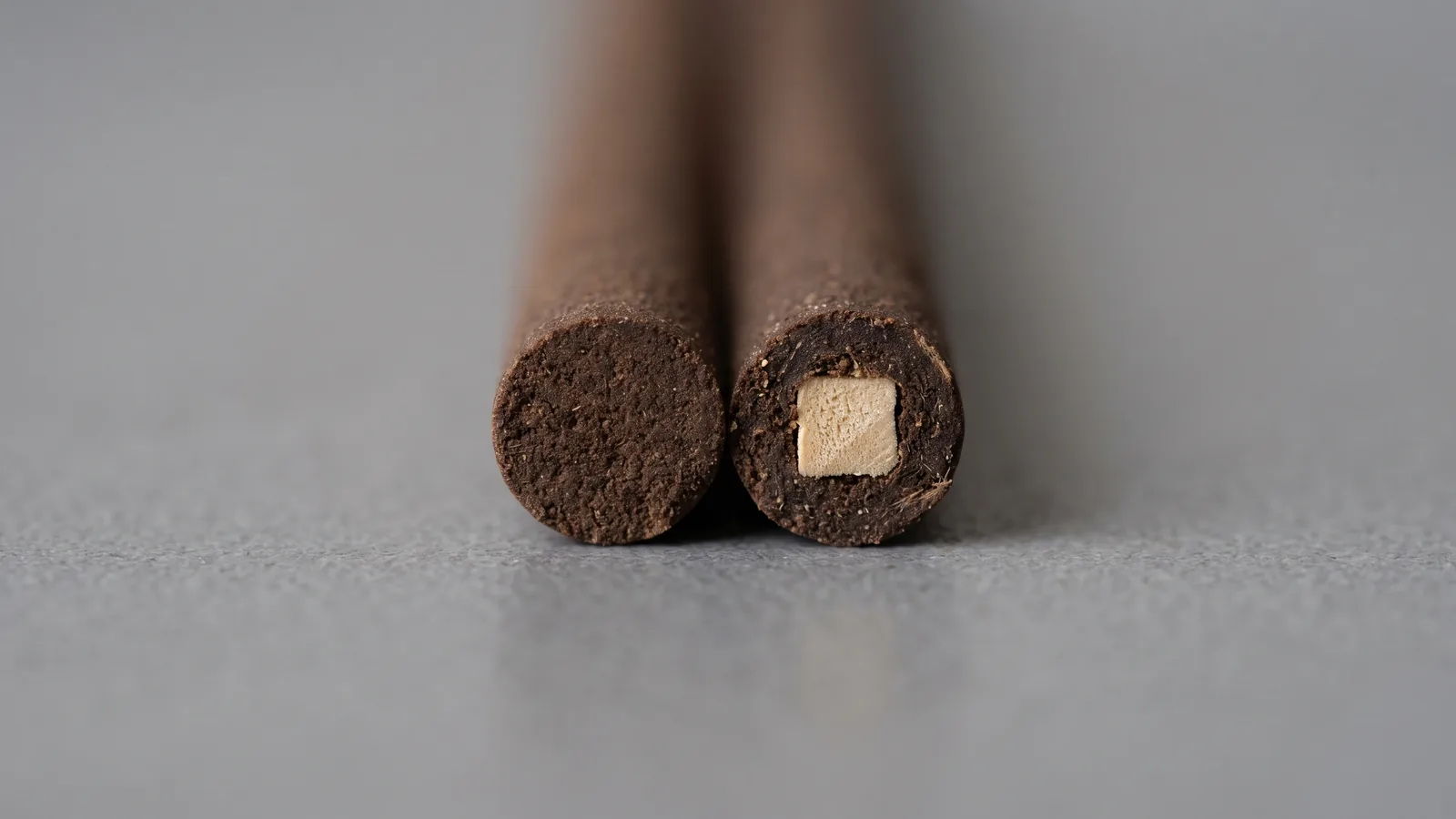
Snap one and the question answers itself
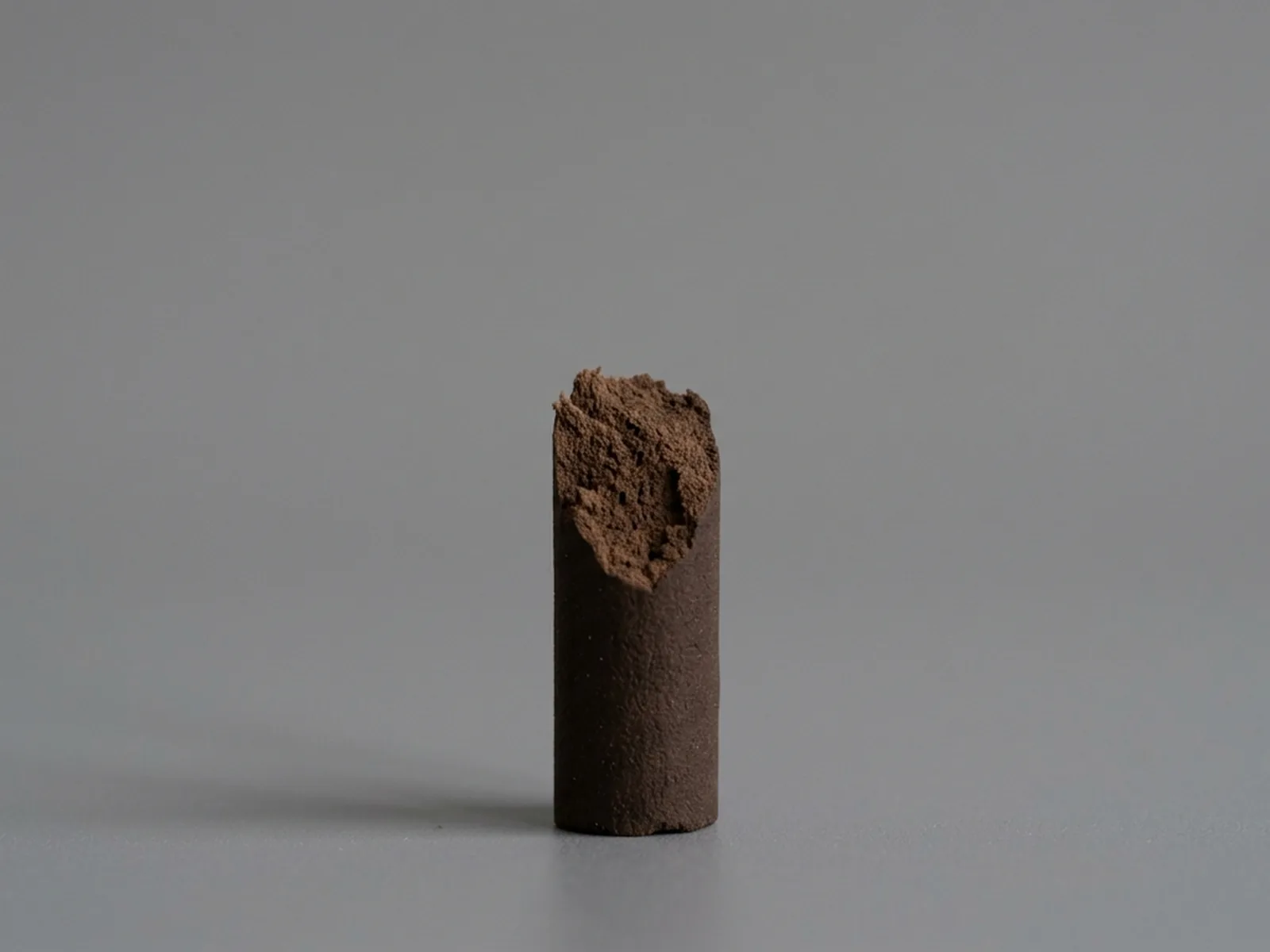 A
ACoreless: one material, edge to centre.
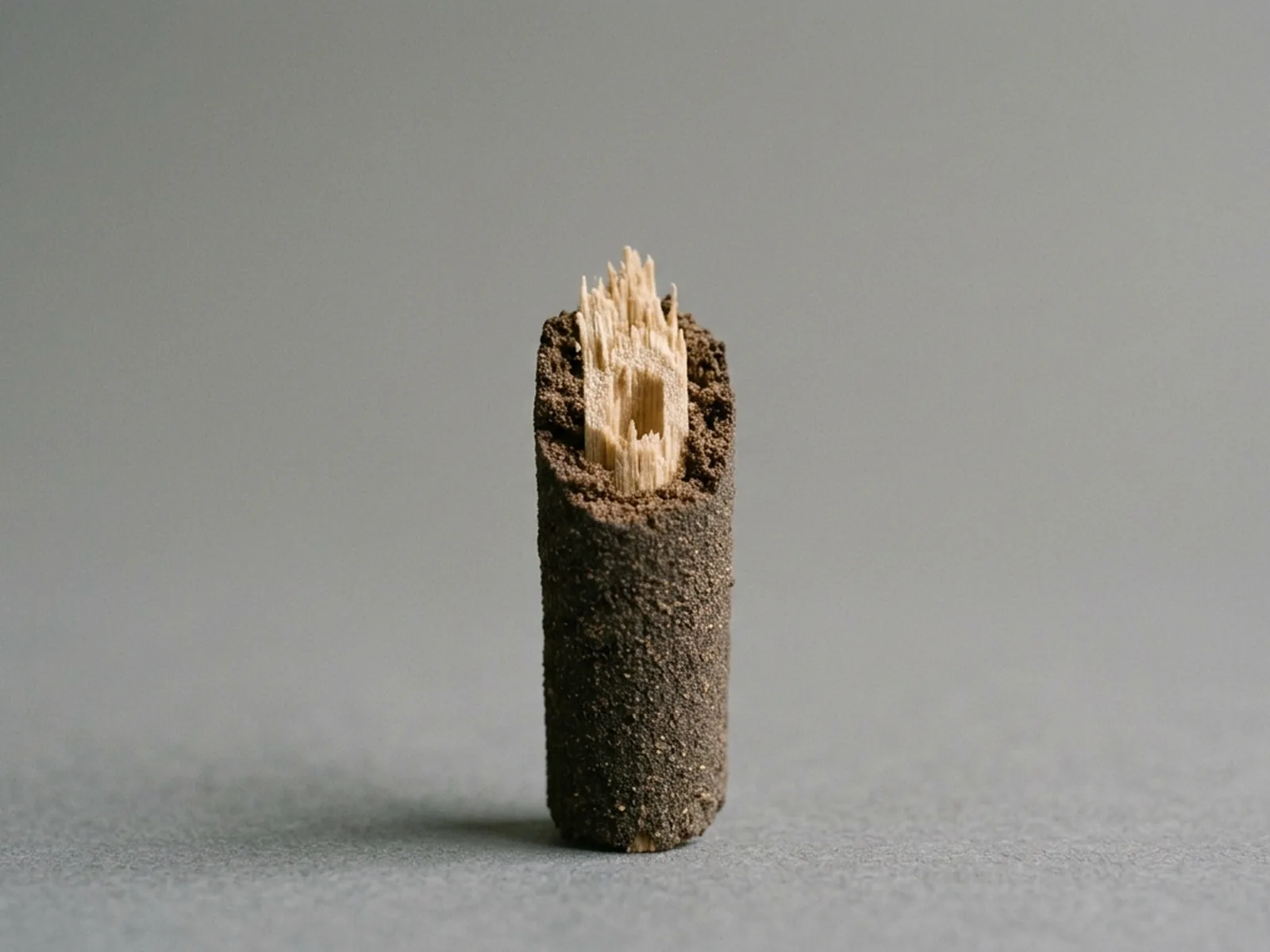 B
BBamboo core: the pale fibres at the centre are not agarwood.
The trade-off, in both directions
What coreless costs, honestly
Three things, and any supplier who tells you coreless is simply better without mentioning them is not being straight with you.
Production cost. Extrusion is slower than rolling and the reject rate is meaningfully higher, because a solid rod of incense paste with no internal support is fragile before it dries. That shows up directly in unit price.
Fragility in transit. Without a skewer providing tensile strength, coreless sticks break more easily. They need a moulded tray rather than a loose sleeve, which adds packaging cost, and careless handling downstream will still produce breakage. We ship them trayed and see under 1% loss; bulk-packed coreless is a different story.
Burn speed. At identical diameter, coreless burns slightly faster, because the entire cross-section is combustible aromatic material rather than partly inert bamboo. If your retail claim depends on a specific burn duration, you may need to step up a diameter to hold it.
Where the core genuinely helps
It is worth stating the case for cored construction rather than treating it as the cheap option, because in some applications it is the correct choice on technical grounds.
Long formats. A 30 cm stick at 3 mm diameter is mechanically demanding, and above about 21 cm we would recommend a bamboo core, or a minimum 2.5 mm diameter if you insist on coreless. The Gulf market's preferred long formats are cored for good reason.
Hospitality and high-turnover use. Where sticks are handled repeatedly by staff, transported between rooms, or stored loosely, the mechanical robustness of a cored stick has real operational value that outweighs the tail-note issue.
Entry price points. At the bottom of a range the cost difference is often exactly what makes the margin work, and a customer burning incense as background scent in a large room is not listening to the final third of the burn.
Packing and transit: the part that decides your loss rate
This is where coreless programmes most often go wrong, and it is entirely preventable.
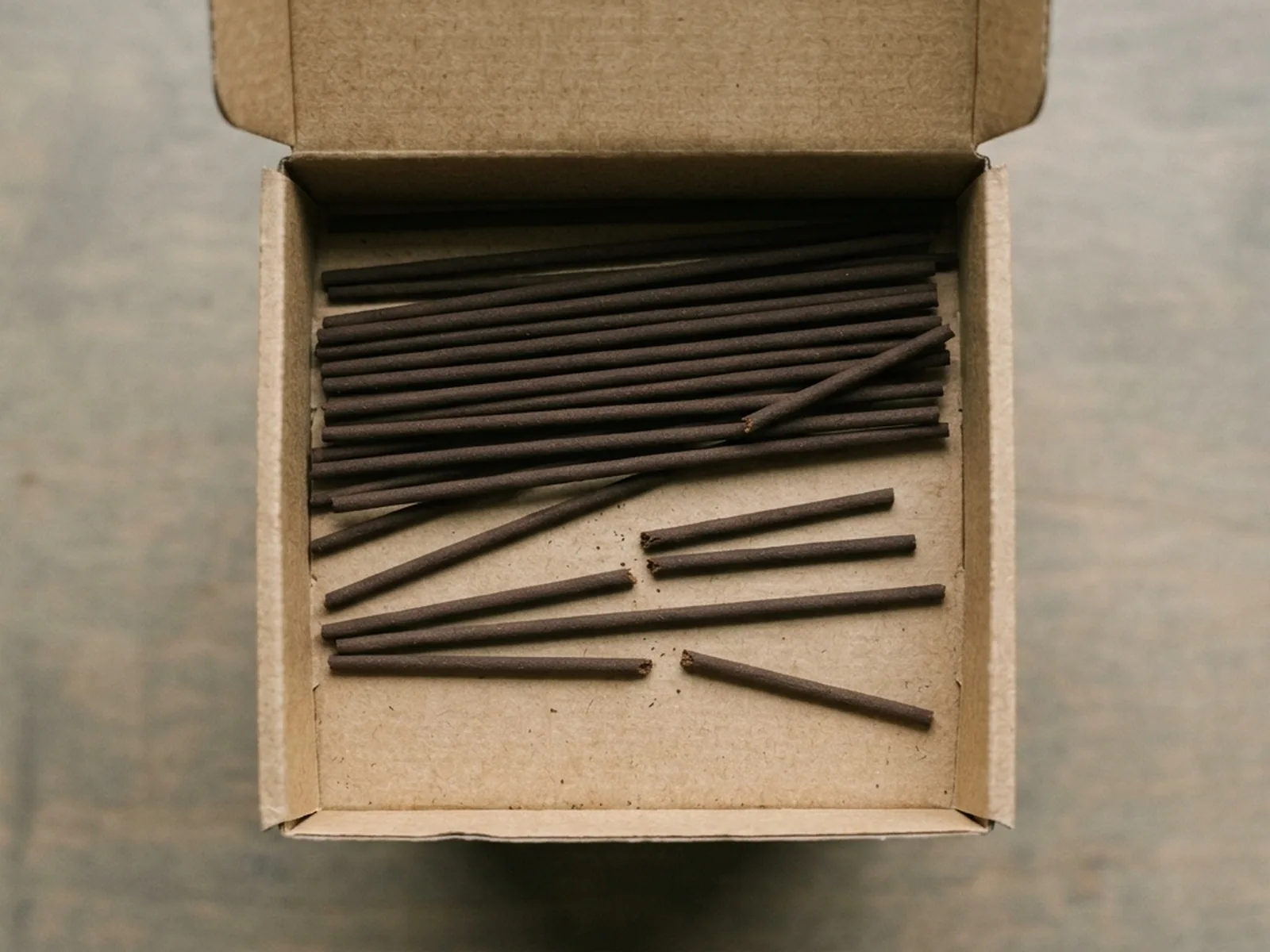
Without a skewer, a coreless stick has very little tensile strength across its length. Packed loose in a sleeve, a box that is dropped or compressed in a master carton will arrive with a proportion of the sticks snapped, and the customer opening it sees a broken product rather than a premium one.
The fix is a moulded tray inside the box that supports the sticks along their length and prevents them shifting. It costs a few cents per unit and it takes breakage from a visible problem to under 1%. We ship coreless trayed as standard for exactly this reason.
Two downstream traps to watch. First, if you re-pack at your end — into gift sets, for instance — keep the tray or replicate the support. Removing it to save space reintroduces the whole problem. Second, if you ship onward to retail customers in small parcels, coreless boxes need to travel in a filled carton rather than loose in an oversized one, because the movement is what breaks them rather than the impact.
For long formats the effect compounds. A 30 cm coreless stick at 2.5 mm is fragile enough that we would specify a rigid box rather than a sleeve as a condition of supply. And we would generally steer a buyer toward cored construction at that length unless there is a specific reason not to.
What a wrong packing spec looks like on arrival
Choosing for a market, and building a range
Market by market: which construction to stock
Japan takes coreless, effectively as a condition of entry for premium retail. Japanese buyers evaluate the full arc of a burn and a bamboo tail note reads as a manufacturing shortcut. Combined with the short formats that market prefers — 10.5 cm and 13.5 cm — coreless is also mechanically unproblematic there.
The Gulf and wider Middle East is comfortable with cored construction and its preferred long, thick formats genuinely benefit from the structural support. Coreless has a place at the top of a GCC range as a differentiator, but it is not the expectation.
Europe and North America sit in between and are trending toward coreless at the upper price points, largely driven by specialist and wellness retail where customers read ingredient and construction detail. At entry level, cored is fine and the smoke question matters far more than the core question.
Southeast Asia is mixed and price-led in volume, with a sophisticated enthusiast segment at the top that knows the difference and will ask.
The four axes that actually decide it
| Incense sticks without bamboo | Bamboo-core sticks | |
|---|---|---|
| Burn signature | One material throughout, so the final third smells like the first | The core burns too and adds a papery note in the final third |
| Breakage in transit | Higher. The stick is the material, so it snaps rather than bends | Lower. The core carries the load |
| Typical market | Japan, niche perfumery, wellness retail | Gulf, South and Southeast Asia, temple and volume supply |
| Cost at the same blend | Higher: slower extrusion, more careful drying, more transit packing | Lower: faster to make and more forgiving to ship |
How to structure your range
Carry both, and use the distinction as your trade-up mechanism rather than choosing one and defending it.
Cored construction at your entry and volume price points, where the cost difference is what makes the margin work and where the customer is buying scent for a room rather than a burn to pay attention to. Coreless above that, positioned explicitly on the construction difference. It is one of the few product distinctions in this category that a customer can verify themselves in a single burn. That makes it unusually easy to sell.
A range with only cored sticks has no upper tier and no obvious reason for a customer to spend more. A range with only coreless sticks is priced out of its own entry point. The two-tier structure solves both, and it costs nothing beyond carrying one more SKU.
How coreless sticks are actually made
Understanding the production difference explains the price difference better than any argument about quality. It helps when you are justifying the premium to your own customers.
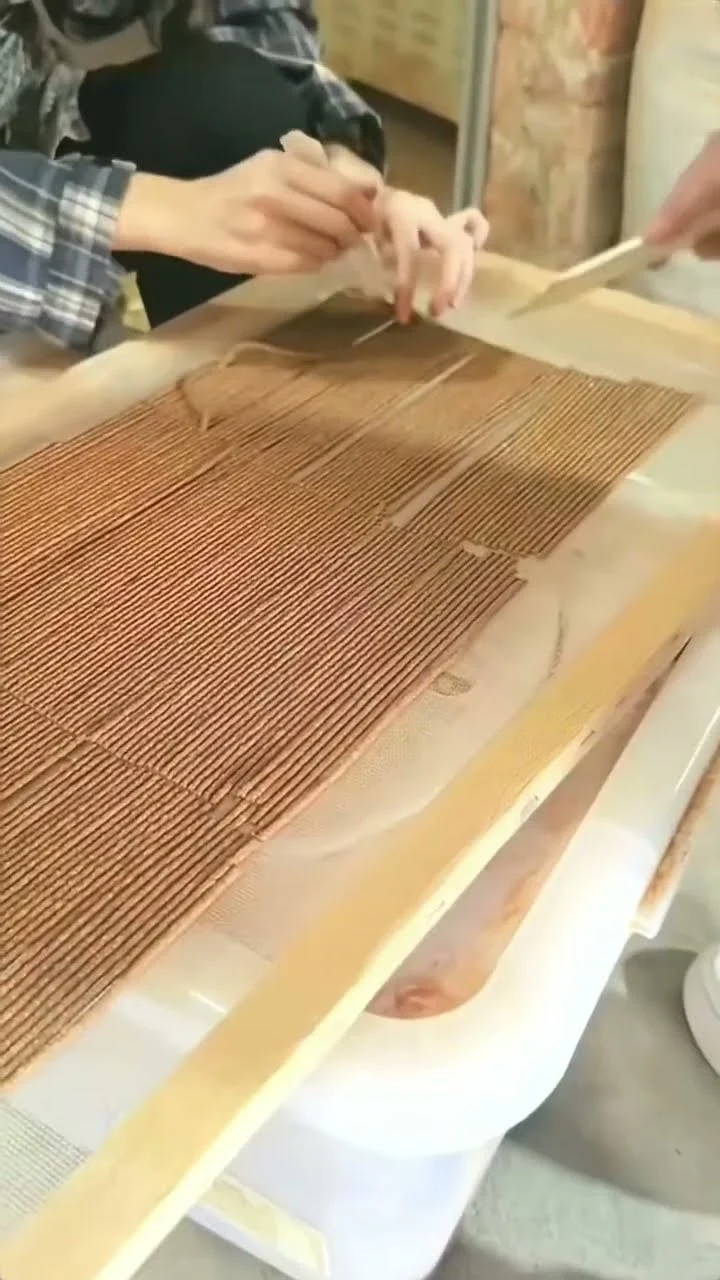
A cored stick is made by rolling. Incense paste is applied to a bamboo skewer and rolled — historically by hand, now usually on a machine — until an even coating builds up. The skewer provides structure throughout, so the paste can be relatively soft and the drying can be relatively fast. Reject rates are low.
A coreless stick is extruded. The blend is forced through a die as a continuous rod and cut to length, with nothing but the paste itself holding the shape. That imposes constraints at every subsequent step.
The blend has to be dosed precisely, because too much moisture and the rod slumps while too little and it fractures at the die. Drying has to be slow and even, because differential drying rates warp the stick, and warping puts it outside a dimensional tolerance that is tighter than most buyers assume — the group standard for agarwood burning products specifies stick diameter to ±0.15 mm and curvature at 3% or less, measured by the light-industry method it references [3]. And handling before the stick is fully dry has to be minimal.
The consequence is a slower line, a higher reject rate, and more skilled attention per unit. That is where the cost sits. It is not a premium extracted for positioning — it is the arithmetic of a harder process.
It also explains why coreless quality varies more between suppliers than cored quality does. Rolling is forgiving; extrusion is not. If you are comparing coreless samples, dimensional consistency across a box is the property that reveals how well a supplier actually runs the process.
The five steps, and where each one goes wrong
Mill and sieve to a nominated mesh
Coreless has no skeleton, so particle size does the structural work. Coarser powder gives a weaker rod, and the difference shows up in transit rather than on the bench.
Blend with natural makko at a fixed ratio
Binder is what holds the rod together and what carries the burn. Too little and it breaks; too much and the agarwood is diluted by material the buyer did not order.
Extrude as a solid rod
This is the step a cored line does not have. The paste is forced through a die at a controlled rate — inconsistent rate is the origin of most diameter variation.
Dry slowly under controlled conditions
Forced fast drying causes surface cracking and dimensional drift. It is also the cheapest corner to cut, which is why it is the most common one.
Pull a test rod and record break strength
A rod that passes here is what your packing spec is designed around. Skipping this means the first strength test happens in your customer’s carton.
Merchandising it, and specifying it
How to explain the difference to your own customers
This is one of very few product distinctions in this category that a customer can verify themselves in a single burn. That makes it unusually easy to merchandise — provided you frame it around the experience rather than around manufacturing.
What does not work: leading with "extruded rather than rolled" or "no bamboo core". Both are true and neither means anything to someone who has not thought about how incense is constructed. Manufacturing detail is a supporting argument, not an opening one.
What does work: "the last few minutes smell as good as the first". That is the actual customer-facing benefit, it is specific, and it invites a test the customer can run themselves. Shelf-talker copy along the lines of "burn one of each and pay attention to the final third" converts unusually well precisely because it is falsifiable — a claim a customer can check is a claim they trust.
For staff training, the useful framing is that the bamboo is fuel, not just structure. Once a salesperson understands that the skewer is burning too, the explanation becomes obvious to them and they can deliver it without a script.
Sampling supports this better than any other product distinction we sell. If you run in-store burns, this is the comparison to run.
What to put on the purchase order
Construction, explicitly: coreless or bamboo core. Do not assume it from the price. Diameter and length, with tolerance. Binder ratio. And, if you are ordering coreless, confirm the packing method — trayed or sleeved — because that single detail determines your transit loss rate.
Ask for both constructions in your sample set even if you think you know which you want. Burning them side by side and paying attention to the last 5 minutes is a 15-minute exercise that will inform every subsequent order you place.
A note on how to phase this if you are switching an existing range. Do not convert every SKU at once. Take the one line where the burn is most likely to be noticed, usually your highest price point, move that to coreless, and leave the rest cored for a full reorder cycle.
You then have a genuine comparison running in your own channel, on your own customers, rather than a supplier assertion. If sell-through moves, convert the next tier down. If it does not, you have learned that at your price points nobody is listening to the final third. You have learned it for the cost of one SKU.
The same logic applies to breakage. A coreless line will produce a higher transit loss rate than the cored line it replaced. The honest question is not whether that happens but whether the margin absorbs it.
Track damages as a percentage of units received for one full cycle on the converted SKU before you commit the rest of the range. Most buyers discover the number is smaller than they feared and larger than the supplier implied. That is roughly what you should expect from both sides.
References
- [1]Standardization Administration of the PRC. GB 26386 — Safety technical requirements for burning incense products. Mandatory national standard (PRC), 2011.
- [2]Naef R.. The volatile and semi-volatile constituents of agarwood, the infected heartwood of Aquilaria species: a review. Flavour and Fragrance Journal 26:73–87, 2011.
- [3]Hainan Agarwood Industry Association. T/HAIUA 001-2024 — Agarwood burning products. Group standard (voluntary), 2024.